

The
200% Marriage
Podcast
With Meredith & Craig
The
200% Marriage
With Meredith & Craig
Subscribe to the Podcast




Listen
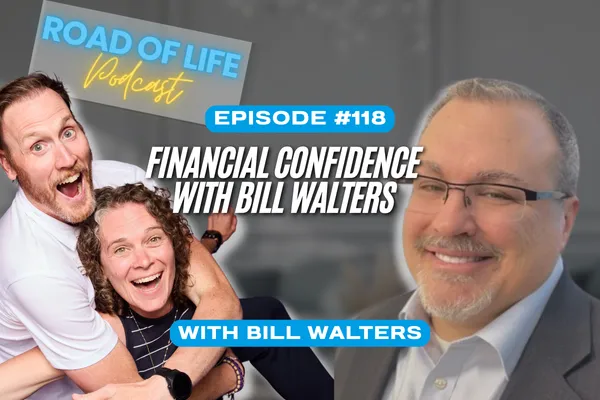
118. Financial Confidence with Bill Walters
Listen Now
Episode TranscriptionMeredith & Craig (00:01)
Meredith & Craig (00:01)
Life, yes you're on it Let every mile bring a smile, yeah
Meredith & Craig (00:09)
Welcome to the Road of Life podcast, the show for married entrepreneurs who want to build a thriving marriage and a thriving business. We're your hosts, Meredith and Craig, relationship experts and entrepreneurs ourselves. We know firsthand that your business will only grow as strong as your marriage does.
On this podcast, we share real stories, practical tools, and honest conversations to help you strengthen your relationship, fuel your business, and build a life you love together. Let's dive in.
Meredith & Craig (00:33)
In this episode, Bill talks about spending six years caring for his mother during her battle with dementia and the lessons he learned and shares with his clients about helping people build a financially confident future. Bill drops massive wisdom about loving yourself, living in abundance and building your stable financial future.
And Bill shares a definition of love that you don't want to miss.
Meredith & Craig (00:55)
Welcome to another episode of the Road of Life podcast. We have an awesome guest, Bill. Welcome to the show. Bill, we're really excited to have you.
Bill Walters (01:03)
Thank you so much, it's pleasure to be here and love this time of year and the ability to meet with you guys and share some life.
Meredith & Craig (01:12)
Yeah, it is a great time of year, it? Thanksgiving is one of my favorite holidays. It's a holiday with built-in gratitude. I don't know, just, and like with copious amounts of food and football, what can beat that really when you think about it?
Bill Walters (01:25)
⁓
It's kind of a perfect setting, Gratitude changes everything.
Meredith & Craig (01:32)
does, yeah, so true. And we're grateful for having you. Talk to us a little bit about your journey into entrepreneurship and how you got here kind of thing, your origin story, if you will.
Bill Walters (01:44)
Well, thank you. I guess it goes back to that when I was in school, I wanted to make a difference and help people. And I thought it was in the world of accounting, because, you know, my mom was an accountant, my aunt was an accountant. And yet when I look at graduating and getting the degree in finance,
That's not where I ventured out into. so the story of helping others was that when I graduated Drexel, the first thing I did was become a coach for Special Olympics. I helped my friends and family get set up so well that they don't really need to talk to me about finances now because it was done in the early nineties. And so
And they're just happy because they got involved 30 years ago and everything I said would happen came true. But I guess where I am now is the fact that when my dad was on his deathbed and he reached up in his Navy way and grabbed my forearm and said, take care of mom. And I said, yeah, dad, I got this. And then he really grabbed me and he says, no, mean, take care of mom. So he knew.
what that meant. And obviously I did not know what that meant. So the next six years were spent, I was my mom's long-term care plan. And I'm like, wow, I'm making a lot of mistakes out of love. And how can I shorten that learning curve? And for six years, we created a space full of light and love.
and a way to organize someone transitioning into their golden years as they had Alzheimer's and dementia as best as I could, right? And that led me to thinking, well, what if I could shorten that learning curve to 15 minutes and educate people how we can protect and prepare
our parents while they're still cognizant and get their wishes and dreams and not be a burden to our children at the same time. And so I really started focusing at that point on being there and present and listening to people. And then the goal was to educate them or leave them in a better off space than when I first met.
Meredith & Craig (04:06)
Wow, that's powerful, Bill. Like I can imagine that taking care of your mom and building her plan for her in those moments over those six years couldn't have been easy. It couldn't have been an easy sort of case study for the rest of your business, so to speak. It couldn't have been an easy time for you as a son or in your business capacity. And so I just, think it's really powerful.
that you're taking what must have been a really hard time and a mountain for you to climb and saying, wow, I can help a lot of people with what I just went through and see if I can make it smoother and easier for people to relieve that giant burden. Caregiving is a huge burden in addition to the financial stress that comes along with those later years. And so I just think it's really beautiful that you've taken what
must have been a painful experience in your life, a difficult experience in your life, and you're trying to make that better for so many other people. Yeah, it's really rare, like you're a rare human, that you're going through an experience, a very challenging experience, but all the while thinking, how do I make this better for the next person coming behind me? How can I shrink this?
you know, four years, five years, six years learning curve into 15 minutes so that the next person doesn't have to, because time is of the essence in those moments, right? And so how do I shorten it for those people? And I just love that.
Bill Walters (05:29)
Well, thank you. think it was never a burden to me. When I was born, I was born with hip dysplasia and I dislocated my hips six times between the ages of three and a half and eight. And at that time, the treatment was eight weeks bed rest. And so was my mom who had to take care of me. so bed rest means that when I needed the channel changed on TV, ⁓
I had to ring a bell. It also meant when I had to go to bathroom, I'd ring a bell. So I was like Pavlov's dog, you know, where I was conditioned, love. So when it was my turn to return the favor, you know, each time that I had bed rest, I had to relearn how to walk. I had to go through physical therapy. And I wasn't allowed to do...
Meredith & Craig (06:16)
Yeah.
Bill Walters (06:21)
Children's activities that were jumping and bumping like normal kids. In order to attend kindergarten for some of that time, they had to transport me in a little red wagon and it had a football player whose son played for the high school football team carry me into the classroom and set me up in what they built in wood shop, which was a bed. And so I'm sitting in a bed in a classroom and you know, so I was
set aside, right? And so I learned how to adjust and adapt. And when it came to caretaking for my mom, it was not a second thought. It was how can I make it the best version of life possible for her? Removing fall risks, putting up bed alarms, going with her on doctor's appointments, analyzing the medication and making her take it because
At one point we learned that she forgot that she already took it twice one day and we had to call the hotline and say, what do we have to do? And I had to keep her awake for 24 hours, which was really difficult because she took three times the amount of the medication that she should have. And we had to stay awake and we couldn't use caffeine because that would make our heart race. So we had to think of ways to keep her focused and awake. so that's what we did.
I learned I learned how to put in a rope and so and this is gonna sound so crude but When people get older and they push off from the commode they use their upper body strengths They have two sides. Well, she wasn't really strong enough to do that. So what I did was I took a giant rope with knots in it much like the rope you would have in ⁓ That would tie up a ship to you know
mooring or or or or tie around and i would put knots in it and that way and it was it was put into the wall at the two by four so it doesn't look aesthetically pleasing but it's just her bathroom but she was able to lift herself up that way easier than pushing on the sides little adjustments like that right ⁓ but making a diet that agreed with her right take you sending your senior trips
and just monitoring everything. So it wasn't a chore task, it was just something that I thought was necessary. And as I'm gaining this knowledge, I said, let's help other people. Let's create a system where I can explain what I did and then they can streamline that. I can give them information on adult incontinence diapers and how to prevent
from seeing spots and spiders because that means that they're dehydrated to having them hear voices, which means they're hallucinating. That means they might have a UTI, right? All these things, when you learn, you know the solutions. And once you know those solutions, it makes a difference. And look, all you really wanna do is make their transition smooth. And as the caretaker, you just want...
Meredith & Craig (09:18)
Hmm.
Mm-hmm.
Bill Walters (09:33)
Smooth highway no speed bumps and he just you just want them to be happy and you to be happy and she wasn't a violent or throw throw a fit she was very calm and kind and loving and we had no episodes of meanness the matter of fact if I want to know where she was in the house I look for the cookie trail because she loves sneaking cookies
Meredith & Craig (09:55)
It's probably a bit full circle. It sounds very loving. What I heard is, you know, it didn't feel like a chore because it was just done out of love. and vice versa with when you were, you know, suffering from your hip dysplasia when you were young, your mom just did whatever was needed to be done to care for you, to love on you. And you just returned that, you know, that love.
Bill Walters (09:57)
Yes. Exactly.
Meredith & Craig (10:19)
and that's just what we do for those we love is we just do whatever is required to make them more comfortable. It sounds like you, learned a lot when you were younger, when you went through your, your time where, know, you were bedridden or you were, you know, going to school and sitting in the bed in the school. Like there was a lot of creative ways that you had to adapt to be able to maintain a quality of life.
for you at that stage. And it sounds like you've applied a lot of those lessons on getting really creative to help your mom maintain her quality of life and keep her dignity and be able to live the best life she could given her circumstances, similarly to when you were a child. It seems like you learned a lot of skills or had your mind open to adaptability and creativity. And there's always a way to figure it out if it's important and something that you want to do, you will figure it out. And it sounds like you've applied a lot of that.
kind of later in life in this phase.
Bill Walters (11:16)
It's 100 % applied. When you have fear and doubt and you want to control an outcome as opposed to having a mindset of love, the approach is different. So you want to switch out of fear.
You want to switch your mindset out of fear and surround it with love and light and and move it over to permit to love to get rid of that hardening of your heart. So when you're in a difficult situation or you're trying to control an outcome, instead of worrying about tomorrow, just worry about today and tomorrow. Take care of itself. And when you look at someone that's harmed you or hurt you or it's creating doubt, you want to thank them for making you aware.
Forgive them if they hurt you and transfer that fear, anger, denial, control into light and love so that you're open and you're putting out a vibration that is positive, right? And when you attract positive love and light in, then you share that with others because your goal is to leave someone better off after they've met you. So that they're, even if they're 1 % better,
Your day is complete because you made a difference in their lives.
Meredith & Craig (12:42)
Where does that come from, Bill, that mindset? Like, not everybody has that, not everyone thinks that way. Where does that come from for you?
Bill Walters (12:50)
Well, I believe in a higher power or source or God. And so he loved me first and therefore I love back. And so for me, spreading that word that...
You're committed to helping someone create a lifestyle of abundance, of health, strength, vitality, that when you put your faith and trust into a higher power, that you're not setting up, there's a glass ceiling that you break through, right? And you're setting expectations of abundance, right? And when you set those expectations of abundance, abundance doesn't mean wealth abundance.
Although many people like that type of abundance. It's health, it's wisdom, it's discernment. when you're grateful for what has been given to you and you share your gifts with others to improve their life quality and you remind yourself that if you're kind to yourself and you love yourself, right? That you can then love
others and love on loving on them is just feeling a need that they have in the moment right whether it's financial whether it's giving them the proper advice so when you give when you find the balance between personal interest and life interest right and you and you know that now you can give back you can mentor and you can and in the mentoring you can teach someone how to fish instead of giving them a fish right
It makes a huge difference in the lives you touch.
Meredith & Craig (14:25)
Love that, especially, I really zeroed in on the part where you talked about being kind to yourself and loving yourself so that you can love others. That's a big part of our relationship philosophy. One of our five key commitments is the commitment to yourself so that you can love yourself because you can only love someone else to the degree you love yourself. And I'm curious, kind of building off your last question, is how did you always have that?
kindness and love for yourself like since you were a child you remember it that way or is that something you've had to learn along your life?
Bill Walters (14:59)
I be...
remiss if I said I knew it as a child. I think that it's something that was learned in the process of growing up and still being refined, right? Because you're given different circumstances in different stages in life and you're not given more than you can handle. so it's not everybody wants a smooth road with no speed bumps and or
They don't like the roller coaster of up and down and up and down. But it's the enjoyment of the up and down is what life's all about. When you, when you smell the roses, when you take time to appreciate what's around you and when you love on yourself, you enable yourself to receive when you receive.
you're able to give that love back so it does the complete circle, right? Because you can't be in love until you demonstrate love to yourself. You can't show love until you understand what love is. And then you want that same feeling to go to your partner, to a relative, to your kids and the people that life should touch.
Meredith & Craig (16:08)
Yeah, so true. And I love what you said, your definition of love. Love, basically is filling the need of the other person in the moment, whatever it is they need in that moment, you filling that need is showing them love. Talk to me a little bit more about that. Because I've never heard anyone articulate love that way. And I like it.
Bill Walters (16:22)
Yes.
Well, you know, when you're in a relationship, it's knowing the other person's love language, right? Like if they despise unloading the dishwasher and it takes you five minutes, then unload the dishwasher. If they don't like going to the dry cleaner because none of their clothes need to be dry clean, it's only your clothes, then you just do it yourself, right? But when you learn how to satisfy a need, whether it's small or large, right?
you create a moment of happiness because you're putting someone else's needs in front of your own. So you're being selfless and that act of giving, whatever that small act is, is appreciated. Whether it's articulate or not is not the importance. The importance is doing the kind deed, doing it out of, your heart. You're not doing it tit for tat. Well, I did the laundry. Your turn to wash. No, it's not that. It's that you're doing the kind deed.
Meredith & Craig (17:24)
Yeah.
Bill Walters (17:25)
Right.
Meredith & Craig (17:26)
Yeah.
Bill Walters (17:26)
And you're not building a list. Well, I did 99 things for you this week and you only did 32. Well, at some point in life, it's going to level out. Right. So you're not keeping an accounting sheet. You're, just being kind. Right. And making a difference. And correct. Correct. So, you know, so how does this translate into what I do and why I do what I do? Right. Is normally the question that gets asked.
Meredith & Craig (17:40)
Yeah. Kindness for the sake of kindness over scorekeeping. Yeah. Yeah.
Bill Walters (17:55)
The answer is simple, right? When you put someone else's needs first and you solve, you have a conversation, a rarity nowadays, and you spend the initial conversation, why call stage one, is just spending 15 minutes with someone on the telephone and asking them some basic questions about their goals, dreams, and desires, and then taking those needs and desires and asking further questions like, where are they now?
versus where do they want to be, right? In the second meeting, which is an hour long, we create illustrations and explain all the big definitions and details as a roadmap that gets them to where they want to be. And then the third meeting is just starting the underlining process and putting in the application for them to get started. And it's not a pressure.
thing or a sales thing if it matches their goals in life. Now, sometimes there's speed bumps in that process like credit card debt or they're not saving enough or the Amazon driver who delivers on a daily basis knows the family's first names which is not what you want. So, or that they go to a large national coffee retailer and we'll just say that their name has star in it.
and they spend $30 a day on coffee when they can have a Keurig or an espresso machine in their house and they're not wasting $210 a week on coffee. And you could then take those savings and put it towards retirement by just redirecting their priorities so that they have a nest egg that they could land on it.
retirement, that's theirs. This is what they want. I know what the budget looks like in retirement, explaining to them that this is what it looks like. You could take two vacations, and you could still spoil the grandkids, etc., etc. Right? So when you make it to their level and about them, it's a lot easier, right? And it just then starts with something simple, like we meet,
We talk, we meet again, we talk some more and I explain. And it just takes one thing, an open mind and an open heart to change because the behavior of the past is going to change for the behavior of the future. But the benefit at the end of the road is that they don't have to work as a greeter at Walmart at age 87, right? They can just retire the way they want to retire.
Meredith & Craig (20:40)
It's powerful. I love your point that an open mind and an open heart is what's required for change. And I mean, that's from your world. I mean, we come from the relationship world. It's the exact same requirement over here. An open mind and an open heart being willing to to embrace something different, to have something different. So I love that. I'm just wondering just, you know, for my own sake, what's the most common, you know, when you start working with clients?
I assume there's several changes that get made depending on what their current habits are, but what's the most common sort of quick win your clients often start with? How do you redirect them? What's something, a habit change or the most common sort of change in their usual structure that allows them to start making progress in the right direction?
Bill Walters (21:28)
I think it's a couple of things and I'll keep the answer short and sweet. The first thing I review is their credit card expenses. What they buy on a regular basis, what are the repetitive buys and is it making sense? The next thing I review is their budget. Gas, electric, cell phone, cable TV, entertainment, food,
gasoline or to fill up your vehicles, rent slash mortgage and vacations. And I look at what they do and how they live their life. And then I look for ways to save money on their standard budget. And the last thing I looked to save the money on is healthcare cost. Cause I have a way of reducing their healthcare costs by upwards in the US by
30%, sometimes as much as 70 % for their family. So we look for ways of savings in the beginning. And if we could save them, meaning the family, between $300 to $1,200 a month in their everyday expenditures, they have more disposable income then, right? So it's about benefiting them, right? Now, sometimes families don't earn enough. So they have champagne taste and Miller Lite budget.
Right? So you suggest they get that not one person, but they both get second jobs so they can create from those second jobs, disposable income for, for better food at home, for dance lessons, for Susie, for, violist, violin lessons for Sam, whatever it may be. Right?
So you create a better family and you're, you, don't, they don't have to do this all the time. It's short term, but you're, you're giving people options. If they're in credit card debt, I teach them how to get out of credit card debt. And so there's a lot of things you can do to make someone's life better, but you don't know that until you go in and start a conversation. And when you start the conversation, you're doing it out of love.
You're not asking him questions like on question one, a it says, should ask you about, know, what you're doing. No, ask them, what are you currently doing now? What's most important to you? So we tackle that first. You know, what have you been doing so far? Now, a lot of times in the U S right. The biggest fallacy is, oh, I have a 401k. It will be enough. And that's 1971 thinking.
Okay. 401ks are a great way to say tax deferred, but it's not the end all be all. Right? So a lot of times I'm very excited when they leave a job, a big corporate job, and they go to another location and they have this 401k sitting there and they don't know what to do with it. I know the one thing you shouldn't do with it is cash it in. A, taxes are going to kill you.
especially starting next year when they go up 8 % across the board in the US. But two, okay.
I can teach them how to double it in 10 years without any further contribution. Right? So they're like, wow, that would never happen if I had a 401k. So once they have an open mind and an open heart and they say, wow, there is a better way. I'm like, ⁓ okay. Then it works.
Meredith & Craig (24:58)
Mm-hmm.
Very cool. I want to go back because it was way back when we started this conversation. I just found it super fascinating when you, back in the 90s, you were helping your family. And that's kind of how you started on the financial side with your family. It's interesting because...
What we find a lot when we're talking to people and in our own life is that when we're talking to family, a lot of times family do not necessarily believe a prophet in their own backyard. It's almost like they have to hear it from another source. You could say it till you're blue in the face 100 times over and then they'll hear it from someone else that they don't have that relationship with and it just hits different. But that wasn't the case with you.
I'm wondering if you had any insight or any tips or tricks or things that you did that hit home for your family that made it so that they were like, ⁓ I'm going to do this. Bill knows what he's talking about. I'm going to follow.
Bill Walters (25:57)
Well, I asked them a simple question.
and it was this. If you continue what you're doing at your current pace, you'll retire with this. If you listen to me and the projections come true, when they come true, it's this. So when you retire, do you want to retire here or here?
Now, if you want to, if you think you have all the answers, that's great. Get left behind. You can retire with this, but the ones that listen are, and then I'm going to be the first one to say, I told you so, right? At the family meals, you could have listened, right? That's how I did it. Okay. Now I didn't say every family member and cousins and aunts jumped in. A few family members, a few friends, and then, and then referrals.
Meredith & Craig (26:34)
Thank you.
Yeah.
Yeah.
Bill Walters (26:51)
from those people, right? Because I have family members that are going to have worked for 40 years and haven't saved enough. And they know what I do. And they don't have a financial advisor. And it doesn't matter because I laugh and I'm like, so when are you going to retire? We can't. You should have talked to me in 91. Okay. You would have the nest egg you need to retire, right? And they start mumbling. I'm like, look.
Meredith & Craig (27:14)
Yeah.
Bill Walters (27:22)
People have listened and when they listen and it comes true, that's the aha moment. So I have somebody that I met and I told him that his money would double in 10 years and he didn't believe me. He said, ah, the proof's in the pudding young man. And I'm like, okay. And then 10 years later, he's like, it more than doubled, it almost tripled. I'm like, I'm sorry for over producing.
And he's like, no, no, no, do it again. I'm like, I can't promise you it'll be like that again. But he's like, yeah, I'm not ready to retire. Do it again. I'm like, okay. So it's, it just, you only can work with those who are placed in front of you. Family, family members, a lot of times are like fish. It stinks after three days, right? They don't trust you. They want someone else to be the guinea pig. And that's fine because
Meredith & Craig (27:49)
Yeah.
Yeah. ⁓
Bill Walters (28:16)
you don't know best and yet total strangers trust you and they reap the benefits of your knowledge. Right? So no big deal. You can only present what you can present.
Meredith & Craig (28:23)
Yeah.
Yeah. Yeah. It's kind of amazing. I love your, I love that. You know, total strangers think you're a genius, your own family. Yeah, whatever. You're just you.
Bill Walters (28:37)
But look at what happened to Jesus. He went back to his hometown and they didn't recognize him for what he was, right? And so his solution was next town. And it's the same situation with family. You only can present them an opportunity. If they choose to ignore you, it's okay. You just move on to the next person, you know, next because you...
We wanna help those who wanna be helped. Open mind and open heart. So if their open mind and open heart are not there, it's okay. Timing's not right.
Meredith & Craig (29:09)
Yeah.
Yeah. You can't drag people into their own future, right? Like you can present the opportunity and if they don't see it, they don't see the vision, they don't see the vision. And it's something that I've had to grapple with that it's not my responsibility to one, drag them into their own future and to force them to see the opportunity that's in front of them. It's, you know, present it and if they take you up on it, great. And if they don't, then love on the people that are willing to do the work and move forward.
And I think it just comes with experience because in the beginning, you know, we all got into whatever it is we're doing. We got into the relationship space. You got into the financial planning space and we want to change the world. We want to change everyone's world. We want to help everyone because we know how good it can be. And we want everyone to live in this place and live in a happy marriage and live in confident retirement plan. We want to help everybody. And so when we first start, it's like
I'm here to change everyone and change the world and you're so enthusiastic and I think it comes with a little bit of experience that I can't drag you kicking and screaming into your happy marriage. I can't drag you kicking and screaming into your financial future. You have to have an open mind and an open heart and it just, the wisdom of seeing the difference in that I think just comes with some experience and love on the people, love on them both. Love on the people who do have the open mind and open heart and bring them where they wanna go and love on the people who don't have the open mind and open heart and.
You love them anyway because even though you can see a different life for them, they can't see it for themselves and you can't want more than they do. And so that's just a lesson I've learned, I think, over over years of experience that you'd love to help everyone. You would love to. You just you just can't help everybody.
Bill Walters (30:48)
It's true when you meet someone you have to go into a situation with an open mind and an open heart and with no judgment. And by that I mean this, that I've met people that were earning $300,000 a year and were $270,000 in credit card debt and I met somebody who was earning $65,000 a year
and is retiring with a million dollars. So, you don't judge a book by its cover and you meet them where they're at. In the moment, what can I do for you that's going to make it better? No judgment. You don't have to worry. Don't be afraid or embarrassed to ask the difficult question. I'll answer it. You know, so it's like having the white elephant in the room. Okay? So, you just want to help people.
And so sometimes the biggest thing is, the first question that comes out is, am I saving enough? Right? That's a great question.
In all the countries outside the US, the average family saves 20 % off the top and puts it away for a rainy day. Do know that 90 % of Americans right now in that neighborhood are living paycheck to paycheck right now? 90%. Meaning they're spending their money and they're not saving. And the average American, as it stands right now, so
90 %
slightly more, will retire with less than $100,000 to last them for their retirement cycle. So the scary part of that statement is if nothing gets done about the current state of the union with Social Security, because nothing was done, and this is not a political statement by any stretch of the imagination, when the walking dead was president, nothing was done to Social Security. When President Orange
who's currently in office has done nothing to promote the state of improving social security. The thing that's on the books that would extend the savings of social security another 10 years to pay people out is by cutting current benefits by 20 percent. But that doesn't solve the problem, right? The problem is that they're going to go bankrupt. And so if you have less than $100,000 saved,
you're going into retirement at say at age 70 and you whittle through that $100,000 judiciously in five years, right? How are you gonna put food on the table if there's no such security or something similar to that? That's all we're talking about is feeding people. Okay, so we have to do a better job in saving. We have to do a better job of game planning for the future and we also have to do a better job of caretaking for
Meredith & Craig (33:28)
Mm-hmm.
Bill Walters (33:42)
the people we love and setting them up in a situation that shows your love by preparing them for the future and preparing yourself for the future.
Meredith & Craig (33:52)
Why do you think there's such a discrepancy in the rest of the world, you know, taking 20 % off the top and then 90 % of Americans not having- anything set aside.
Bill Walters (34:02)
I don't think you're gonna like my answer. We live in a world of instant gratification. I want it now. I need it now. It's like a three-year-old stammering for the doll in the doll shop, right? And they're used to getting instantly. I want a job that pays me $100,000 a year while I sit in the basement in mom's house, eating meatloaf, playing video games at 3 a.m. and I only want to work six hours a month.
Meredith & Craig (34:03)
.
Bill Walters (34:27)
Well, that job doesn't exist for most of us.
Am I saying you have to take the road of hard knocks? No. I'm just saying that whatever you earn, learn how to budget for 80 % of that disposable income to spend, not 100%. So act like it's take the first 20 % and set it aside. And if you get into that habit, not living up to your budget, life will be good.
Meredith & Craig (34:53)
Yeah. If you just pretend that other 20 % just doesn't exist, just put it aside and pretend it does not exist. Don't look at it for another 40, 50, 60 years, whatever it is, but just don't touch it. Don't look at it. Just play with your 80%. That's your budget. Live within that and lose the sense of entitlement, I guess, is what I'm hearing. There's a bit of an entitlement. Yeah.
Bill Walters (34:57)
Correct.
Correct, but that 20 % that you set aside, you don't want to bury it in the mattress or in the yard. You want to talk to someone like myself. Yeah, you want to take that 20 % and you want to put it to work for you so that at some point in life, your money's working for you and you're not working for the money, right? And you can do that with a normal progression in salary. If you start your salary at $40,000,
Meredith & Craig (35:20)
Yeah, fair, What a growing. Get Bill on the phone.
Yeah. Yeah.
Bill Walters (35:44)
And when you retire, you're at 85,000 and you're doing the same 20%, gradually as you get increases in your life, the savings increases take place. And then putting it in spots, because it's not how much you save, it's where you save it. That's the key.
Meredith & Craig (36:02)
So if we had someone right now who was like, okay, I need to do more. I need to set aside my 20%. And I gotta get someone like Bill on the phone. I gotta get Bill on the phone to figure out how I'm gonna get this money working for me. How do they reach out to you, Bill? How do they find you?
Bill Walters (36:18)
Well, they can either go to my website at www.perfectlyimperfectfamilies.com or they can reach me on my cell phone and I have no problem sharing that publicly, which is 267-278-5062. Ultimately, just schedule an appointment. It doesn't cost anything. It's...
a way to have a conversation where you're not pressured and we can then determine if you're even a fit for this type of game plan because it requires some sacrifice. Okay. I it means that you can't get front court seats at a basketball game once a year. And that's really what the difference is. You know, if you could set aside and here I'll do it simple as little as 250 dollars a month. If you're young to a maximum of
thousand dollars a month. Okay, that gives you your range. And the longer you put it away, the more compound interest it earns income tax free so that when you take distribution, the government doesn't get their hands on it. And I'm not talking about a Roth. I'm talking about a tax free retirement.
Meredith & Craig (37:27)
That's awesome. And we'll have all of Bill's contact information in the show notes so we can reach out and click the link and book an appointment to talk to Bill or get his phone number and give him a call. Because you're right. We see it all the time. It's getting worse and worse for people. The cost of living is getting so high and people are worried that in their retirement, they're not going to have enough food to eat.
We're not doing all this hard work and building this life to just be worried about where our meals are going to come from. We want more than just to be able to eat when we retire. We want to be able to go on a vacation and live and see the world and experience the grandkids and spoil the family and all that hard work we did over the course of our life. We wanted to pay for that lifestyle that we kind of want at the end. So yeah, we'll have all that information so you can reach out.
Bill Walters (38:17)
Yeah, I do want to do one quick public service announcement. Okay, so.
Meredith & Craig (38:20)
Please do, please
do.
Bill Walters (38:22)
In life you have an opportunity to invest in yourself, right? So in this case, when you invest in yourself, I would highly advise that you invest in, into Meredith and Craig's guidance, okay? And now they didn't ask me to say this, okay? So I wanna say that, that when you invest in your relationship and you build on that building block there, you enable yourself to grow.
and appreciate one another's company. And then that's going to make retirement so much more enjoyable because you're going to do it with your best friend. And you're to be able to experience culture and life differently than arguing through it like you see on so many sitcoms. So if you think about it, if you're financially healthy and you're mentally healthy and you combine the best of both worlds, it creates an ideal environment to be the best version of yourself.
Meredith & Craig (39:15)
Well said, Bill. Couldn't have said it better myself. What a great way to end the show. And your check's in the mail, Bill. I'm just kidding. We did not prompt that, but thank you. Yeah, that's a great point.
Bill Walters (39:25)
Well, look, if you
speak the truth, then and that's all you speak, then people understand. Invest in yourself, learn how to love yourself, then you can love others, and then you prepare. Okay, because people are relying on you. Okay, you don't even know it and they're relying on
Meredith & Craig (39:43)
So good. Thank you so much, Bill. So appreciate you coming and sharing your wisdom.
Bill Walters (39:47)
⁓ Thank you for allowing me the privilege of being here and I wish you and your family blessings upon the holiday seasons and I look forward to the next time we chat.
Meredith & Craig (39:57)
Awesome, thank you.
Meredith & Craig (39:59)
Thanks for listening to this episode of the Road of Life podcast. Remember, your business will only grow as strong as your marriage does.
So it's one action you're gonna take this week to put something you learned in this episode into practice. Because we love a good chit chat as much as the next person does. But without action, stay where you are.
If you want to turn your marriage into the engine that drives your business forward instead of the brakes keeping it stuck, book a free marriage and business strategy session with us at 200percentmarriage.com/strategycall. We'll see you next week.
Meredith & Craig (40:30)
Life, yes you're on it Let every mile bring a smile, yeah

Meet
Meredith & Craig
Life partners, business partners, and best friends. We left the corporate grind to become fulltime entrepreneurs... with no idea what we were doing.
That made for some interesting, amazing, stressful, awesome, painful, scary, awful, awesome, insightful, unbelievable decisions, moments, experiences, relationships, and quite honestly, we wouldn’t have it any other way.
Our marriage is the foundation for everything else we build in our lives. It is a cheat code for life, and we believe that having that part dialed in levels up every other part of life.
We help others live their dream life... and that starts with a rock solid relationship so they can level up the rest of their lives too.
Tune in for a dose of laughter, love, a gentle ass kicking, and game-changing wisdom that will help you unleash your potential and build the life of your dreams together.
Subscribe to the Podcast


I really enjoy listening to these two share their experiences and stories. They always have an honest and lighthearted take, even if the subject is serious.
- Carrie
Charlottetown, PE
How To Reconnect, Bring Joy and Fun Back To Your Marriage, And Be A Team Again, in 12 Weeks
Without Marriage Counseling, While Having Fun Doing it.

In this FREE Training You'll Discover How to Conquer Communication, Reignite Intimacy, Rebuild Trust & Bring Back The Love, Joy, And Fun To Your Marriage. So You Can Feel Loved and Appreciated, Without Spending Hours In Marriage Counseling and While Enjoying The Process.

Connect with us on:


© 2026 All Rights Reserved | Road of Life Coaching, LLC
PRIVACY POLICY | Terms and Condition
Custom Crafted By ExpertSites