The
200% Marriage
Podcast
With Meredith & Craig
The
200% Marriage
With Meredith & Craig
Subscribe to the Podcast




Listen
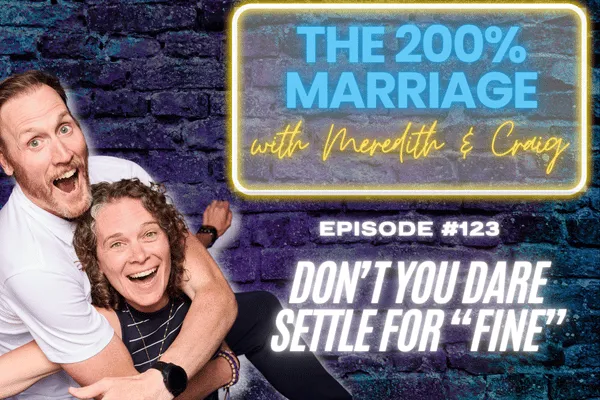
123. Don't You Dare Settle For "Fine" (Chapter 2) | The 200% Marriage Podcast
Listen Now
Episode Transcription
📍 Welcome back to another episode of the 200% Marriage Podcast with Meredith and Craig. If you've been paying attention, we are reading the book, the 200% Marriage. There's a little series we're doing in the podcast where we read a chapter and then we talk about the behind the scenes, the stories, the concepts.
Maybe we'll have an interview or two here and there. Last week we got into the meat and potatoes of the book. Part one, chapter one. I read that. We're basically just reading the chapters that we each wrote. Chapter two is, "Don't You Dare Settle For Fine." Mer's story.
She's reading it. Let's go. Alright, chapter two, "Don't You Dare Settle For Fine." Don't settle for a relationship that won't let you be yourself. Oprah Winfrey. Let me start with, I had a fantastic childhood. I had two parents who loved me very much. Supported me, believed in me, and instilled in me the belief that I could do anything I wanted.
Both of my parents supported and encouraged me in sports and in school. We went on regular family vacations. In fact, those are some of my favorite childhood memories. Some of my least favorite childhood memories are of my parents' arguing. I think my parents tried their best to argue behind closed doors, but both were yellers and their raised voices carried.
As kids, we were often worried that every fight would lead to them getting a divorce. We didn't really have any friends with divorced parents when we were kids, so I'm not even sure where that fear came from, but it was there. Looking back, I think that for both of them, the yelling was about wanting to feel heard, seen, understood by the other person, but they were probably both so entrenched in their own side of the argument that they couldn't see or hear the other person's perspective, so the yelling escalated. In those situations. They both just reacted. Neither of them was taught how to regulate their emotions and respond in a productive, constructive way when their emotions were high. Not their fault. Their parents certainly didn't learn those skills either, so they didn't respond productively.
They reacted emotionally. Whatever they were feeling exploded out of them. My dad especially liked to make himself big and get really close to you, to intimidate you into backing down. He also used to use mom's vulnerabilities as ammunition against her in arguments or use them to be mean when he felt insecure or attacked.
Neither of them learned how to fight fair in an argument, and then when the yelling stopped and the argument was over, we were relieved, but we never saw them repair. We never saw an apology. We never saw the emotional validation. From what I could tell, the issue wasn't usually resolved. It was just swept under the rug and ignored until it was tripped over again later, and then again, and then again.
So long story short, I didn't learn how to regulate my emotions. I didn't learn how to respond instead of react. I didn't learn how to fight fair. I didn't learn how to resolve conflicts productively. I didn't learn how to apologize and repair. I didn't learn how to show up vulnerably and hold space for another person to do the same.
And it's not my parents' fault. They didn't learn it either. The thing about growing and evolving and becoming the best version of you is stuff is gonna happen to you, and that's not your fault. And that stuff is probably gonna suck.
You're not gonna learn what you need to know, and you're probably gonna learn stuff you need to unlearn. But once you realize the difference and lean in, this is an important part. It becomes your responsibility to learn it or unlearn it. So I'm taking responsibility to unlearn some of what I learned growing up, and I'm taking responsibility to learn what I didn't learn growing up so I can have a thriving marriage so that I can become the best version of me.
Vulnerability, communication, conflict resolution, apologies, how to give the benefit of the doubt, how not to keep score, and how to love to the best of my ability. It may not come as a surprise that my parents eventually broke up. It didn't come from a loud bedroom fight like we thought it would when we were kids.
It came from infidelity. My dad had an affair and that rocked my whole world. I was 20 years old to say I really struggled with it would be a huge understatement. I blamed my dad for the breakup of my family. I felt like he abandoned us. I felt like he had an affair on all of us, like on my mom, obviously, but also on me and my two sisters too.
When the affair came to light, our whole family had a face-to-face reckoning, and it was probably the most painful moment of my entire life. It started with dad denying the affair. I wanted to believe him so badly, and I felt so guilty that the people who loved him most in the whole world didn't believe him.
I just sat in the floor and cried. My two sisters spoke their minds and held their boundaries. I was the oldest and I sat in shock, guilt and shame on the floor.
At that same time, I was in my first serious long-term relationship, so I was also experiencing this through the lens of that relationship with him, not just my relationship with my dad. The only thing I remember saying that day was, my boyfriend would never do this to me, in a pretty disappointed and also pretty self-righteous tone.
Spoiler alert. He eventually did do that to me. Believe it or not. I learned a couple of important and actually really healthy relationship skills from my dad in the wake of this experience. He gave me space to process the situation. He didn't push me to talk to him before I was ready. Eventually, he picked me up to take me for a drive and we ended up just sitting in his truck in the driveway.
And letting it all out. We had an incredibly honest conversation. He let me vent, he let me speak my mind. He let me cry. We both cried. He let me be angry. He let me be sad. He let me be me. He didn't shy away from my feelings. He didn't argue with me about my feelings. He just let me feel them. And after a couple of hours, I got out of the truck and went back in the house.
And although I definitely wasn't over it. He and I could at least start trying to move forward again. If we wanna just fast forward really quick so that you're not left hanging here. I did get over it. My dad and I actually ended up with a fantastic relationship. That's the first time in my whole life that I can remember not sweeping a problem under the rug probably 'cause it was just such a massive problem.
There was no rug big enough to cover it, but it was still the first time I remember having a really difficult conversation about something instead of just ignoring it. Something else I've learned since that experience is that there are always two people involved in the collapse of a relationship.
Given my parents and my own experience with infidelity, I really thought the unfaithful one was the one who ended the relationship, but that's not true. It takes two people to put a relationship in a place where one person feels the only way to get their needs met is to go outside of the relationship.
Don't get me wrong, that's a really shitty decision to make, but it doesn't happen in a vacuum, and there's enough accountability to go around. Needless to say, not having healthy communication and conflict resolution and vulnerable conversations role model to me, and instead learning the opposite, how to fight unfairly, how to not resolve conflict and fight over the same things over and over.
How to not emotionally regulate how to not validate someone else's feelings and how not to hold space for another human ensured I replicated those patterns in my own relationships for a long time. What I learned from my parents' separation and my own relationship breakup. Was that I couldn't trust people, that people will hurt me, especially the ones who were supposed to love me the most.
Those experiences colored how I approach relationships for the next decade. So let's talk more about the end of that relationship I was in during my parents' divorce. When I found out he cheated on me. I didn't leave because I didn't feel like I was worthy of having a happy, healthy relationship with someone who wanted to spend time with me and who was proud to be with me.
So I stuck around for another year till I finally realized I was completely dependent on him for how I was supposed to feel. Is this supposed to be funny? I don't know. Is he laughing? Yep. Okay. That's funny. Am I supposed to be happy? I don't know. Is he happy? Nope. Okay. Nope. I'm not happy. And once I realized that I had completely lost myself, I had to walk away from that relationship.
It was tough. Interestingly, my friends were thrilled with my decision because they hated seeing me shrink and lose parts of me that made me, me. They saw what I couldn't. A community that loves you can be a very powerful tool if you leverage it. After that relationship, I was single for a decade. That's a long time when all of your friends are coupling off, getting married, buying houses, and having babies.
I wasn't gonna let anyone else hurt me like that again, and I didn't. The thing is though, I didn't even realize that that's what I was doing. I didn't know how to protect my heart. I didn't know that to protect my heart. I had put up walls and refused to let anyone in. I pretended I wasn't doing it. I was going through the motions, doing all the online dating thing.
I went on dates, they sucked. I hated dating my friends. Gave me a hard time for never going on second dates. They told me my expectations were too high. If they thought I should settle, but for me, settle was somehow a four letter word. I know it's actually a six letter word, but you know what I mean. It was a bad word.
Something inside of me refused to settle. Looking back, I can clearly see my fears were holding me back from meeting someone. Thankfully, there was also a little voice inside of me that refused to settle that knew that none of these bad dates were who I was meant to be with. The relationship skills I learned growing up and what I learned from my parents are great examples of what happened to me wasn't my fault, but once I became aware that I was hiding behind the walls I built to protect myself and relationships, it became my responsibility to change.
It became my responsibility to unlearn skills and behaviors that weren't serving me and to relearn healthier skills and behaviors that would serve me. And not to spoil the surprise, but that's exactly what Craig would help me do. Before I wrap this up, I wanna give a giant shout out to my parents, despite how tumultuous those first weeks were.
They managed to stay friends. Even just last summer, 20 years after they split, dad put up mom's clothesline and because they remained friends, we never had to do two Christmases or two Thanksgivings, or two Easters. We always celebrated the big days together as a family. And I'm really grateful to them for that level of growth and emotional maturity, especially my mom.
That couldn't have been easy, especially that first year after they broke up. With the enormous benefit of hindsight. I can see now that I learned two huge lessons from my experience being single. One, don't settle. And two, the universe is always working in your favour, even when it seems like it's not.
Never, ever. Ever settle settling tells the universe you are not worthy of having what you want, that you're not worthy of having a life that you love. It reinforces any beliefs or thoughts that you are not good enough and not worthy of love that lights your soul on fire. One of my very favourite quotes from my very favourite TV show, Ted Lasso makes this point beautifully.
It's from my favourite character, Roy Kent. He says, you deserve someone who makes you feel as though you've been struck by fucking lightning. Don't you dare settle for fine. Not that it's any of my business. Interestingly, I had the opportunity to go back to that old boyfriend during my decade of singleness, but I somehow managed to not crawl back into my comfort zone.
I somehow managed to trust myself enough to bet on myself for just a little bit longer, to lean into my new life and give myself a chance for something more, and something more was on the horizon, something that made me feel struck by lightning. But before we get into that. Let's hear about how Craig learned this shit the hard way.
Chapter two. Chapter two. A lot to unpack there. MacKay. A lot going on there. I'll say. It's incredibly vulnerable, sharing that stuff not just from the perspective of, it's your mess and you're putting it out in the world for people to. See and judge and do whatever they're gonna do with it, but also other people, like we, we alluded to it I think in the last episode.
Mm-hmm. Around how when you share your mess, you're also sharing the overlap of other people's messes. Mm-hmm. My sister is my mom, my dad. That's their story. In this story, you're telling a little bit about your mom's and your dads in particular, and I know that that was. I would say one of our bigger fears with writing the book was how that would be interpreted by our families.
We still don't know. They, I, I'm, I'm actually convinced they still don't know what's been shared in the book. I don't believe any of them have read the book. I agree. They've not said anything. Maybe they're hearing it now for the first time. Who knows. Hi mom. So we're gonna get incredibly vulnerable here as well.
How would your dad feel about, if he were alive today, to hear you read the book or read the book himself? How do you think that he would take this? Yeah, dad, not much of a reader. I, I think he would read it though. I think he would. He's read one or two books in his whole life, 74 years. But this one I think he would've read.
I think so too.
Well, like we talked about couple weeks ago, I think he'd be really proud of it, but specifically around this chapter.
I think he'd feel like I gave him too much credit probably.
I don't think he sees it the same way that I do. I certainly see it very differently today than I did then, very differently. It was, really hard then I was really angry. Then. When did that stop? When did the anger kind of start to lift? A lot of it lifted when we had that conversation, like for months.
I would say like, 'cause that happened at Canadian Thanksgiving in October was when that kind of face-to-face reckoning happened and then leading up to Christmas. So it was a couple of months before dad and I had any conversation. 'cause like I didn't, we didn't have cell phones back then. Yeah, that's, that's how old I am.
So like if, if I just didn't answer the phone when it rang at the house. I just, I didn't, dad called, I didn't answer. So like, it wasn't hard to avoid, to avoid it. So for a couple of months I just avoided him completely. And then one day he was like, let's go for a drive. So he, he prompted the conversation.
Yeah, he just waited and then finally asked.
Where did he and 'cause you talked about in the book that he just let you be angry and let you process your emotions and go through it in that conversation.
Where do you think he learned that from do idea do you think that came about? Because it's certainly nothing I saw from him any other time before that. It's, it, I just, I think it's super interesting that, you know, that's not his. Default setting. Mm-hmm. But he was able to find it in the right moment to reconnect with you and have that conversation.
Maybe he got advice from people. I don't know. That's a great question that I can't ask. Yeah. What about your mom?
How do you think she's going to take what you've written? I was really conscious. Of what you said earlier, that it's not just my story, it is my story. Like it is my experience. It's, it's this story told through the lens of my experience, how I experienced it, the lessons I took from it.
It's not gonna be the same story that anyone else, my sisters, my mom, my dad. It's not gonna be the same story that they would tell. And I was really. Intentional about sticking to my truth of this experience. And not speaking on behalf of anyone else. And so I don't know. It's, it's not gonna be the same.
My interpretation of this experience is not gonna be the same as anybody else. I don't know how she remembers it. I don't know how she experiences it. I don't know how she looks back on it.
I am incredibly grateful, like I said, in the book to both of them, but especially mom, for being able to compartmentalize it a little bit. Yeah. But put her feelings in second place, in the passenger seat. And so that we could all still have, like, we still had Christmas together that first year.
After him leaving and Thanksgiving. Mm-hmm. So that was only a couple of months and that was a fucking bumpy Christmas. Yeah, bet. Like it, it was a very awkward, uncomfortable, difficult, painful, horrible time. Like it was not, not my favorite Christmas. I bet. Not for sure. But also when I look back on it, maybe it is my favorite Christmas because if mom didn't invite Dad for Christmas dinner that first Christmas, would we have had every other one? Would we have had two Christmases, two Thanksgivings, two Easters for the next 20 years? So that Christmas was shitty. But at the same time, it was so necessary so that we could move forward, like as a family unit.
So I'm, I'm incredibly grateful that especially mom was able to do that. 'cause fuck, that had to have been really hard. So I'm incredibly grateful for Mom. Being willing to do that for us. Mm-hmm. And I'm grateful that they had such a overall friendly, productive relationship. Like they obviously owned a business together, so some of that was required. But dad come over and shovel mom's walkway and she'd give 'em a sandwich.
They spoke each other's love language still. Yeah. After all those years. Yeah. Acts of service and food. We talk, I talk about him putting that fricking clothesline and I don't think that, it doesn't do a justice in the book. The clothesline is a power line pole.
And so he's up a ladder. It's 74 years old, hooking up her clothes line and she's beaking at him from behind.
Yeah. And so he's turning around trying to talk to her on the top of this ladder. That's a not on level. I was like, oh dear God, can you not talk to him until he is back on the ground before he falls? But he was. It, it was just such a good example to me of they maintained such a strong relationship through the years.
In large part for our benefit, but not just for our benefit. For their benefit too. And so the biggest lesson, the biggest difference I guess for me, today versus 20 ish years ago when this all happened. Is my take on the level of responsibility that at the time it was just, it was all dad's fault.
I can't believe he did that. That it was all his fault. All the blame went in one place. Yeah. I'm interested to know how you think that that's gonna land with, with certain folks. And it's, it's not, it's funny 'cause we've got friends that are going through something similar right now and she, she and I talked about it and.
She said, you know, it took two of us to open that door. He stepped through it, but it took two of us to open the door. I thought that was a great analogy because that's where my belief is now, from the principle of a hundred percent responsibility, the premise of the 200% marriage is we each take 100% responsibility for our marriage. And so if I'm 100% responsible for this situation, then there's enough accountability to go around. But not everybody believes that when they start out. When you first hear it, it's almost jarring. It's almost like, fuck you. I didn't do it. They did.
It's hard to take responsibility for things because you have to put your ego away. Your ego wants you to be right all the time. Even if that mean makes you a victim. Even as the victim, it's an easier place to stand. Instead of saying, this is all their fault.
How did I contribute to this situation? It's a much harder place to stand. It's a tougher view from that location for sure. But it's the only place you have any power.
It's really hard to believe in extreme ownership and personal accountability in some areas and not others. You either take accountability for your life or you don't. And if you believe you have any power over your life and how it turns out, then you believe you have responsibility to make the right decisions and take those actions to get your life where you want it, which means you have responsibility.
It's very empowering knowing that if it's your responsibility, then that means you have the responsibility to change anything that's going on. It's not the easy button though... in the moment anyway. Yeah, it's long term. I think it's easier, but in the moment it's not, not all. And we're wired for short term comfort, right?
Like, we're always like making the decision, like, yeah, but what makes me feel good now? Yeah. And taking responsibility for a situation doesn't feel that good. It feels better to just, to your point, feel righteous and blame someone else for the situation. I find myself in end of the day though, that just.
It compounds and you just find yourself in that situation for longer and it gets worse and worse and worse because you don't actually take the action to get out of it.
Switching to the other relationship how did you learn to trust again, because you know, you saw it in your dad and your mom there was infidelity, and then not long after you found it in your own relationship.
How did you get past that and learn to trust again and be able to, it's interesting. It's funny 'cause we had a conversation on a walk like last week and I almost was just piecing a few things together on that walk that there were times in our relationship where I found myself faced with a decision.
I could choose to believe that you were the person that you appeared to be, or I could choose to believe that maybe. You were out to get me. But I found myself almost consciously aware a couple of times that I could, trust my experience with you, to trust my experience with someone until they show me.
Because at at some point, I don't know if I knew this then, or I've come to realize it since, or it was always kind of deep in there. But at some point you're gonna get what you expect. So if I keep expecting waiting for the other shoe to drop and you to become this jackass that you're not who you say you are, then I can feel validated when that happens.
Or I can have been looking for that the whole time, and maybe you actually aren't. But that's what I chose to see. And so I some point along the, the journey decided to just take people as I experienced them and not premeditate any resentments or expect that it's not gonna be what it seems.
How did you know not to settle? I have no idea that that, because I didn't, and to spoil it for the next chapter. We'll get into that, similar lessons learned completely opposite ways. I don't know. I've thought about that before and haven't bottomed it out.
What jumps to my mind when we are talking about it right now is my parents supported me and believed in me and, and taught me that I could do anything I wanted to do. And I think that's part of it. I certainly came out of my twenties with an incredible amount of people pleasing and imposter syndrome and perfectionism for a lot of reasons.
But I think I also came out of my younger years, really believing I could do anything if I really wanted to. So. I don't know. Maybe there's something in how those beliefs were instilled in me from my parents when I was young.
And I almost feel like when I think back to some of those godawful dates, like I just couldn't imagine. Living like that forever. And I think because I had spent, you know, a decade basically single with these shitty dates, sprinkle throughout that I'm single now, I'm having a better time by myself than I can visualize having with this person for the rest of my life.
So why would I level down? Be miserable with another human. I don't wanna be alone forever. But I can tolerate that right now. The thought of having to tolerate that forever is, whew, I don't know how I'm gonna do that. Yeah. So I just couldn't fathom any of these people long term. Yeah.
Any last thoughts you wanna leave anyone with?
Nope, that's it. That's how I got so messed up. I mean here. So that's chapter two, and next week, stay tuned. We're gonna hear chapter three. I forget the title of the chapter. Ignore the feather. Get the hammer right. It's appropriate. You'll see why next week. All right, we'll see you next week.
If you want to turn your marriage into the engine that drives your business forward instead of the brakes keeping it stuck, book a free marriage and business strategy session with us at 200percentmarriage.com/strategycall. We'll see you next week.
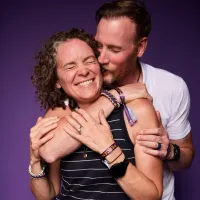

Meet
Meredith & Craig
Life partners, business partners, and best friends. We left the corporate grind to become fulltime entrepreneurs... with no idea what we were doing.
That made for some interesting, amazing, stressful, awesome, painful, scary, awful, awesome, insightful, unbelievable decisions, moments, experiences, relationships, and quite honestly, we wouldn’t have it any other way.
Our marriage is the foundation for everything else we build in our lives. It is a cheat code for life, and we believe that having that part dialed in levels up every other part of life.
We help others live their dream life... and that starts with a rock solid relationship so they can level up the rest of their lives too.
Tune in for a dose of laughter, love, a gentle ass kicking, and game-changing wisdom that will help you unleash your potential and build the life of your dreams together.
Subscribe to the Podcast


I really enjoy listening to these two share their experiences and stories. They always have an honest and lighthearted take, even if the subject is serious.
- Carrie
Charlottetown, PE
STOP SURVIVING.
START THRIVING.
Your Empire Deserves a Kick-Ass Marriage
Most people wait for a crisis to fix their team. We prefer Lead Indicators. Take 2 minutes to get your score and stop guessing where your relationship stands.

(Pro tip: It’s more fun than a tax audit, we promise.)
Not a quiz person? Grab the Winning Playbook instead.

Connect with us on:


© 2026 All Rights Reserved | Road of Life Coaching, LLC
PRIVACY POLICY | Terms and Condition
Custom Crafted By ExpertSites