REAL MARRIAGE.
ZERO BORING STUFF.
With Meredith & Craig
If you're looking for "5 Steps to a Better Marriage" written by someone in a beige sweater, you're in the wrong place. We share the messy, raw and shockingly practical lessons we learned while failing our way to an unstoppable team.

For those women who want more
GODDESS AWAKENING

200% MINDSET SHIFTS
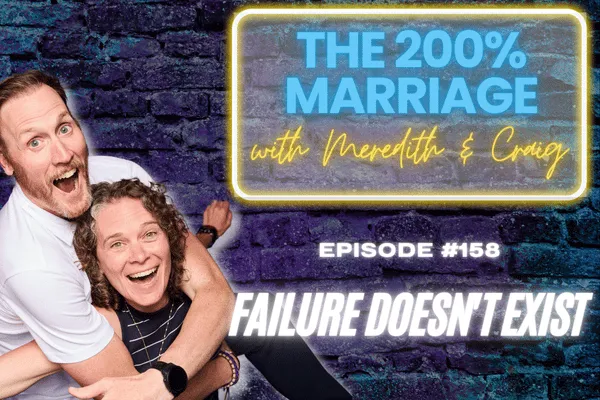
158. Failure Doesn't Exist | The 200% Marriage Podcast
Listen Now
Episode Transcription
I had such a fear of failure that there were times when I would not try certain things that I thought that I would not be good at because I did not want to be seen as a failure.
Made me miss out on such cool experiences because, as we're gonna talk about, it's not all about achieving X. Like, whatever the thing is that you're doing, it's not just about that. But that was my-
very narrow definition of success.
You've built the business, you're crushing it in your career, you've scaled your impact, but are you winning at home?
Welcome to the 200% Marriage podcast. We're Meredith and Craig, and we're here to help you kill that domestic drag and turn your partner into your most elite teammate.
📍 Welcome back to another episode of the Two Hundred Percent Marriage podcast with Meredith and Craig.
What do we got on tap this week, MacKay?
We are continuing with the lessons we've learned over the last three years of doing this podcast. I cannot believe we've been doing this for three years- Three years ... every week.
Wild.
Haven't missed a week. Yep. It's three years.
Crazy.
Three years and two weeks now.
That is correct.
Three years and three weeks now.
That is correct. And this episode is, I believe it's the second lesson. The third lesson, kid can't count. The third lesson of the last three years on this podcast/entrepreneur journey. Even though we've been doing this entrepreneur thing for longer than that, we've kind of just over the last three years kind of boiled these down, these lessons down.
Yes.
And so this week's is an interesting one because it's something that I've struggled with- How ... all my life. Which is? Literally all my life. What is it?
Fear of failure.
Fear of f- Uh, yeah, that is the fear. Um-
I've struggled with fear of failure all my life. The lesson is...
failure does not exist.
Failure does not exist.
And this one is near and dear to my heart because I, growing up, had such a fear of failure that there were times when I would not try certain things that I thought that I would not be good at because I did not want to be seen as a failure.
Mm-hmm.
made me miss out on such cool experiences because, as we're gonna talk about, it's not all about achieving X. Like, whatever the thing is that you're doing, it's not just about that. But that was my-
Mm-hmm ...
very narrow definition of success.
It, it's like we think success is a pass/fail. Like, we either achieve the outcome- Yep
that we're driving for, and only that outcome is success, or we fail.
Yep.
That... Like, I had that black-and-white view, and I see it with these knucklehead nephews down the street.
Yeah.
Like, if they think they're not gonna be good at something, they don't wanna do it.
And I see myself in them.
Mm-hmm.
And it's, it's heartbreaking in, in one hand, and on the other hand, it's, motivating to help them to see it a different way, but my God, they make it difficult.
Like a brick.
You can't tell them anything, just like you couldn't tell me anything.
Mm-hmm.
And so I struggled with it for so long, and I've now gotten to the point where I have to tell myself that there is no such thing as failure.
Mm-hmm.
Because when you think about it, You've got this goal, this thing that you want to achieve, and you set down the path to do this thing, and say you don't achieve that thing.
Well, old me would've been like, "Failure. I own that, and that's, it's now my identity."
I'm a failure. I suck.
I'm a failure. I suck. Versus now, it's like, okay, I didn't achieve the thing, but did I grow as a human in the process? Did I learn some valuable lessons that I can take forward into my life in lots of different areas, but also in trying to achieve this again in the future?
I know what didn't work-
You know? ... so
I'll try something else.
Yeah, Thomas Edison thing.
Mm-hmm.
You know, I've learned 10,000 ways not to invent a light bulb, and then he invented a light bulb. What would we do without the light bulb?
Thank
heavens. What would we do without the light bulb, okay?
Good God. For sure. Especially in the winter, it's
dark. Can you imagine if he let failure, uh, be his identity and, and gave up- Yeah
and, you know?
We'd be all sitting in the dark starting at, like, 4:30 PM in December.
Right. 4:30. I mean- Brr ... earlier than that in some places. I lived some places where it got dark at 2:30.
In the afternoon.
Love those places, love the people up there, don't recommend living there, though.
Sidebar.
It's... Look, just facts.
Not for me. For some people, not me. Uh, but did I learn valuable lessons? Did I become a diff- Did I learn valuable lessons? Did I become a different version of myself? Am I better equipped to take on that task in the future or, and take on that goal in the future? If it's just this very narrow definition of I did not achieve the thing, therefore I'm a failure, and you take that on as an identity, it becomes so much harder to achieve anything after that.
Like, I had a really hard time shaking the failure identity, and the biggest, I would say- push or the biggest, um, variable, the biggest variable into why I thought I was a failure for var- s- for a very long time was my first marriage.
Mm-hmm.
Because when you get married, I don't know if you know this, MacKay-
but the goal is not to get divorced. It is to-
Can confirm. The goal is to stay together forever. S- Forever ever.
Forever ever. Forever ever. The goal is to stay together and to build this incredible life together and evolve as humans together and all the things, and first marriage didn't, that didn't work out.
It was- Didn't take ... it didn't take. For various reasons.
That we talk about in detail in the book. Sha-
Plug
for the book ...
shameless plug, 200% Marriage: Your Winning Playbook to Be an Unstoppable Team, a- at an Amazon store near you. Or honestly, you know what? Just send us an email- We'll send you one for free
that you want the book. I'll give you the book. I'll send it to you. I just want you to read it. I just want you to have the marriage of your dreams. So-
There's that ...
email, you get the book. [email protected]. That's it. Book's yours. Uh-
Anyway.
Sidebar over, but marriage, uh, first marriage didn't go well.
Failed according to old me. Owned that identity. It was part of me. It was like, "I'm a failure. I'm not worthy." Like, it, it just piled on to the point where I, I owned the identity of being a failure which then when you take on other things, it's like, yeah, but I'm, I'm-
Any more?
I'm a single sneezer.
You're a married sneezer.
Fair. I'm a uni-sneezing.
Uni-sneezing. I'm a tri-sneezing?
Usually.
Yeah. Sneeze three times. Another sidebar. Uh, but, but my, my identity was... I was very hard on myself after that marriage, and I was a failure. And so trying new things, getting involved in new things was a lot harder. Thinking positively and thinking the outcome was going to be in my favor was harder.
And when you get into that spiral, it becomes a self-fulfilling prophecy. You don't try things, therefore you don't achieve things. You don't give your all because you don't think you're gonna succeed anyway. You give half efforts, or... It, it just, it's, it's a downward spiral that you have to escape from.
But by reframing the fact that failure doesn't exist, that first marriage, it didn't go as I had planned at the outset of that situation.
Thank God.
However, I became a different version of myself.
Obviously, had to work out that failure stuff first. But I became a different version of me. I learned a lot of lessons of what to do, what not to do, what to accept, what not to accept. I, I gained a lot of data for what I want and what I don't want, and I was able to apply all of that going forward into meeting you.
I wasn't putting up with that bullshit anymore. No, I'm just kidding.
I knew who I had to become, who I had to be. You know, old me, did I show up in a relationship as the partner that I wanted? No, I didn't. B- but I knew after that marriage that I had to. And so that was a big lesson for me, is I have to show up, you know, more empathy, you know, more caring, more-
Discomfort ...
more considerate, more discomfort, having the difficult conversations that I would avoid in the past.
And you took all those lessons into this relationship and taught them to me.
Well, I think you, you undervalue and underestimate what you already knew coming into this. You were very good at relationships anyway.
Mm-hmm.
Uh, so I didn't teach you everything. I think we-
Certainly not.
I think we, we taught each other a lot.
We learn from each other every day, and that's actually a really important, um-
Lesson
for another
one ...
component, component of our relationship, which is, spoiler, coming in future episodes. But failure does not exist. If you can reframe that failure is not an option, you either, you either achieve the goal or you learn valuable lessons, become a different version of yourself capable of, you know, achieving that goal later.
Whatever the case may be. Or
evolving the goal into something bigger and better that you actually want, 'cause you learned you didn't want that thing.
Whatever the thing is. But, but there's always something you can pull from every experience that didn't go as you thought it was supposed to go. If you can pull those and e- extract those and understand that those are actually success, that- that's actually success, then failure doesn't exist to you anymore.
The caveat there, like the big underline highlighted part that we need to, to emphasize is you got to identify the lessons. Like mo- a lot of times we just float through life and we don't take the pause to reflect. Yeah. Like, "Oh, my marriage failed. Oh, this," whatever it was, "I failed at this thing I set out to do.
I'm a failure. I suck. I'm not worthy." And I just take that on and I move on. I don't pause and actually reflect on, "What did I learn by going through this process?"
And that's because a lot of time that reflection is really uncomfortable and hard to- Mm-hmm ... look in the mirror and- It takes accountability
and identify where you didn't maybe show up like you could have.
Yeah.
And what, to your point, what you're accountable for in that process of not achieving the goal that you set out to achieve. And by not doing that, by avoiding that discomfort, avoiding that short-term pain-
Internal uncomfortable conversation
yeah, looking in the mirror, avoiding that is setting you on a path to long-term dysfunction where failure becomes your identity and then you don't try things, and that you lose out on some incredible experiences because you were afraid to try.
Mm-hmm.
So you have to... It's a great point. You have to be willing to look in the mirror and do the reflecting.
"Okay, I set out on a journey that to achieve this thing, and I didn't achieve that thing." Why didn't I? What were the circumstances that I'm responsible and accountable for, that I have control over, that I didn't do or that didn't happen, and therefore I did not achieve that goal? What are those things?
And really get honest with yourself and understand, okay, cool, these three things I coulda done better, differently, that would've helped me get closer to that goal. I'm gonna do that next time.
It's interesting because we used to do this in corporate, although I do feel like it was a lot more of a checkbox exercise and an assigned blame exercise than a personal accountability exercise when we would do a lessons learned after a project was implemented.
Mm. But, like, we at least would go through the motions of that like, in that corporate world, from that corporate lens. But it's not something that I ever took home and did internally for a long time.
Yeah.
And if you don't do that, then this whole failure doesn't exist thing just kind of all falls apart if you don't reflect and get those lessons.
Well, if you don't reflect and get those lessons, you're gonna continue to- Sit
in the feeling of failure ...
and continue to, like, if you can get past the, the, m- the fact that... Like, for me, I, I wouldn't try things because I, I didn't wanna fail. But if you can get past that part and you still try things but they s- they always fail, and you just become like, "Oh, n- nothing ever works out for me."
Fear. Yeah. "Oh, wah, wah." Cloud over your head. Poor me. Everybody going, "Poor me. Nothing ever works out." I- i- it's, it becomes a self-fulfilling prophecy. Like, you do have to have that look back. It, it's really important.
And I think the other element of there is no such thing as failure is looking at the goals and the things that we're trying to achieve, which is how we define failure, not achieving or achieving.
The point of those things, if we re- if we reframe the point of the goals that we set, the point of the goal, the point of writing the book, the point of the marriage, the point of the health goal, the point of whatever it is, is not to check the box and achieve the thing. It's who you become in the process.
And like Brianna Weist talks about it in the book The Mountain Is You, the point is not to climb the mountain. Like, even if you d- look at it from the perspective of a real mountain. Like, if you want... We're gonna climb Kilimanjaro at some point. The point of climbing Kilimanjaro together is not to stand on the mountain and take a picture.
It's who we become in the process of achieving that goal.
Not only as individuals, but as a unit moving up-
Mm-hmm ... the mountain. Mm-hmm.
Like, we're gonna struggle individually. We're gonna struggle as a unit.
Mm-hmm.
There's gonna be moments climbing up a mountain where you're hungry, tired- ... frustrated-
Many of them
and dealing with another human being, and you have to keep in check your fatigue, hunger, frustration, and still- Not- ... manage to get both of you up the mountain.
Yeah, not hand all of your frustration, hunger, and fatigue to your teammate-
Correct ...
for them to hold.
Yeah.
You have to manage that yourself. Correct.
And the other th- the other part of that, We're listening to a podcast right now with Simon Sinek, and he's talking about it from the perspective of AI, but the, the... He, he's written books. We've written books. The point of writing the book is not solely to have that product out there for people.
That's, that's part of it, for sure.
Mm-hmm.
But- It's
a byproduct.
It's- It's a, it's a byproduct of the work we have to go through to analyze our actions, to codify our processes, to create a cohesive narrative, to... Like, the work we have to go through as individuals to create that piece of work that we then present to the world c- changes fundamentally who we are, and we become different people through that process.
That is the point- Right ... of writing the book. Right. That is the point of your health goal. That is the point of your career, whatever the thing is.
Yeah. Yeah, you do have to reframe what success is. And success is, to your point, becoming that different, more evolved version of you that's going to take on bigger and better challenges down the line.
The, the idea of having a book, the idea of climbing the mountain, the idea of having the f- the abs or having the million dollars or having the successful business, those are all a byproduct. So the actual thing that we're trying to achieve is not actually the goal, it's the byproduct of the goal. If we can reframe it. '
Cause the important part is how you grow and who you become and what you learn along the way, the person that you then are stepping out into the world willing to take bigger risks, willing to try new things, willing to create something more valuable for the rest of the world because of what you've already accomplished- Right
because of the person you became.
Right. And you do that By reframing failure to something that doesn't even exist. Like, failure doesn't exist.
Well,
imagine- Like, and it doesn't really, when you think about it.
Imagine if-
What have I failed at?
If you went through life only s- succeeding from the, the d- definition that we started the conversation with, like, I set a goal, I achieve it.
I set a goal, I achieve it. I set a goal, I achieve it. The goals you're setting suck. Yeah. Like, the goals you're setting are too small. They're not challenging you and stretching you- Mm ... which is a podcast we did a few years ago. We were kinda- It was a big lesson ...
we were kinda talking about this l- last night.
Michael Jordan- Mm-hmm ... Tom Brady, like two of the greatest athletes of all time, two of the, I would say, as an identity, biggest winners that society would- Mm ... point to and say- Mm ... like, "Winner, winner, champion." Serena
Williams.
Champion, champion Serena Williams, champion.
Mm-hmm.
You know, 23 Grand Slam titles, seven Super Bowls, and six NBA titles, and all the, all the MVPs and all the things.
They failed more than they won. Like, Tom Brady played, like, 22 seasons, 23 seasons, whatever it was. He won seven Super Bowls, which means that the 15 of those times he failed.
Mm-hmm.
Michael Jordan played, like, 15, 16 seasons, whatever it was, won six titles. Like, so nine or 10 seasons he failed-
Mm-hmm ...
by that true de- by that, like, traditional definition.
The first four or five years of, of Michael Jordan's career, he failed miserably, didn't make the playoffs, got, got his ass handed to him. But in the process of that became someone who could win six.
Mm-hmm.
And if he didn't retire in the middle, possibly eight in a row. And so-
Probably ...
yeah. L- a- and so the, the, the process...
Like, so is he a failure-
Another good
ex- ... because he didn't win a ch- title? Which was-
Another good example of that is John Wooden. Pr- was he, I think the winningest college basketball coach of all time.
Something like that, yeah.
And I think the first, like, frigging, I for- I wish I had the numbers, but, like, eight or 10 years he didn't win anything.
Yeah.
And then he went on to win, like-
11 ...
i- in a row, basically, 11 of 15 or, like, a-
Yeah ...
a lot. And he, he was building a culture and learning lessons and becoming the coach he needed to be, creating the team he needed to have over that period of time through all of that failure to become the coach who could win 11 championships.
A baseball player, they... You get into the Hall of Fame if you can bat 300. That means you get on... You, you hit the ball and get on base three times out of 10. Yeah. That means you don't seven times. Like, you're gonna strike out or, or pop it out seven times before you get on base three.
Mm-hmm.
Like, a- and you're a Hall of Famer.
You're, you're considered- That's success ... you're considered successful- Yeah ... if that's the case. So you're gonna fail more than you succeed. But I promise you that the 10-year-old version of me did not understand that, did not believe that, and thought that you had to hit a home run every time you got to bat, had to win the title every time.
Every game you played, you had to win. And
You'd be a boring human being that never grew if you did that
And that was the early version of me is I, I, I was stagnant and I missed out on some incredible opportunities and things that I could have done th- that I was afraid to do.
Mm-hmm.
And so by now reframing failure as something that doesn't exist, I am now more open to and I want to try things even though I know that there's a good chance that I'm not going to achieve the thing.
I do know that I'm gonna evolve as a human. I'm gonna extract some really valuable lessons that are going to be essential for the next version, the next journey that I take. Love it. So, so failure does not exist is a big one that we've learned over the last couple years. Reframe failure. Do not own it as an identity.
It becomes a self-fulfilling prophecy if you do.
It becomes a self-fulfilling prophecy.
You're choosing that identity Failure doesn't exist. Yay
so that's it for us for this week. Next week we've got another valuable lesson that we've learned over the last three years on the podcast and entrepreneurship, and so stay tuned for that.
Bye for now. Bye. Bye
📍 And that's a wrap on this week's briefing. If this episode hit a nerve, don't let your momentum die Head over to the 200percentmarriage.com/unstoppableteam to take the unstoppable team audit. Find out exactly where your domestic drag is hiding so you can start optimizing your team today. And if you love the show, share it with another power couple who refuses to settle for fine, because a 200% life is better with a community.
See you on the next adventure
ADVENTURES & FAILURES
158. Failure Doesn't Exist | The 200% Marriage Podcast
Listen Now
Episode Transcription
I had such a fear of failure that there were times when I would not try certain things that I thought that I would not be good at because I did not want to be seen as a failure.
Made me miss out on such cool experiences because, as we're gonna talk about, it's not all about achieving X. Like, whatever the thing is that you're doing, it's not just about that. But that was my-
very narrow definition of success.
You've built the business, you're crushing it in your career, you've scaled your impact, but are you winning at home?
Welcome to the 200% Marriage podcast. We're Meredith and Craig, and we're here to help you kill that domestic drag and turn your partner into your most elite teammate.
📍 Welcome back to another episode of the Two Hundred Percent Marriage podcast with Meredith and Craig.
What do we got on tap this week, MacKay?
We are continuing with the lessons we've learned over the last three years of doing this podcast. I cannot believe we've been doing this for three years- Three years ... every week.
Wild.
Haven't missed a week. Yep. It's three years.
Crazy.
Three years and two weeks now.
That is correct.
Three years and three weeks now.
That is correct. And this episode is, I believe it's the second lesson. The third lesson, kid can't count. The third lesson of the last three years on this podcast/entrepreneur journey. Even though we've been doing this entrepreneur thing for longer than that, we've kind of just over the last three years kind of boiled these down, these lessons down.
Yes.
And so this week's is an interesting one because it's something that I've struggled with- How ... all my life. Which is? Literally all my life. What is it?
Fear of failure.
Fear of f- Uh, yeah, that is the fear. Um-
I've struggled with fear of failure all my life. The lesson is...
failure does not exist.
Failure does not exist.
And this one is near and dear to my heart because I, growing up, had such a fear of failure that there were times when I would not try certain things that I thought that I would not be good at because I did not want to be seen as a failure.
Mm-hmm.
made me miss out on such cool experiences because, as we're gonna talk about, it's not all about achieving X. Like, whatever the thing is that you're doing, it's not just about that. But that was my-
Mm-hmm ...
very narrow definition of success.
It, it's like we think success is a pass/fail. Like, we either achieve the outcome- Yep
that we're driving for, and only that outcome is success, or we fail.
Yep.
That... Like, I had that black-and-white view, and I see it with these knucklehead nephews down the street.
Yeah.
Like, if they think they're not gonna be good at something, they don't wanna do it.
And I see myself in them.
Mm-hmm.
And it's, it's heartbreaking in, in one hand, and on the other hand, it's, motivating to help them to see it a different way, but my God, they make it difficult.
Like a brick.
You can't tell them anything, just like you couldn't tell me anything.
Mm-hmm.
And so I struggled with it for so long, and I've now gotten to the point where I have to tell myself that there is no such thing as failure.
Mm-hmm.
Because when you think about it, You've got this goal, this thing that you want to achieve, and you set down the path to do this thing, and say you don't achieve that thing.
Well, old me would've been like, "Failure. I own that, and that's, it's now my identity."
I'm a failure. I suck.
I'm a failure. I suck. Versus now, it's like, okay, I didn't achieve the thing, but did I grow as a human in the process? Did I learn some valuable lessons that I can take forward into my life in lots of different areas, but also in trying to achieve this again in the future?
I know what didn't work-
You know? ... so
I'll try something else.
Yeah, Thomas Edison thing.
Mm-hmm.
You know, I've learned 10,000 ways not to invent a light bulb, and then he invented a light bulb. What would we do without the light bulb?
Thank
heavens. What would we do without the light bulb, okay?
Good God. For sure. Especially in the winter, it's
dark. Can you imagine if he let failure, uh, be his identity and, and gave up- Yeah
and, you know?
We'd be all sitting in the dark starting at, like, 4:30 PM in December.
Right. 4:30. I mean- Brr ... earlier than that in some places. I lived some places where it got dark at 2:30.
In the afternoon.
Love those places, love the people up there, don't recommend living there, though.
Sidebar.
It's... Look, just facts.
Not for me. For some people, not me. Uh, but did I learn valuable lessons? Did I become a diff- Did I learn valuable lessons? Did I become a different version of myself? Am I better equipped to take on that task in the future or, and take on that goal in the future? If it's just this very narrow definition of I did not achieve the thing, therefore I'm a failure, and you take that on as an identity, it becomes so much harder to achieve anything after that.
Like, I had a really hard time shaking the failure identity, and the biggest, I would say- push or the biggest, um, variable, the biggest variable into why I thought I was a failure for var- s- for a very long time was my first marriage.
Mm-hmm.
Because when you get married, I don't know if you know this, MacKay-
but the goal is not to get divorced. It is to-
Can confirm. The goal is to stay together forever. S- Forever ever.
Forever ever. Forever ever. The goal is to stay together and to build this incredible life together and evolve as humans together and all the things, and first marriage didn't, that didn't work out.
It was- Didn't take ... it didn't take. For various reasons.
That we talk about in detail in the book. Sha-
Plug
for the book ...
shameless plug, 200% Marriage: Your Winning Playbook to Be an Unstoppable Team, a- at an Amazon store near you. Or honestly, you know what? Just send us an email- We'll send you one for free
that you want the book. I'll give you the book. I'll send it to you. I just want you to read it. I just want you to have the marriage of your dreams. So-
There's that ...
email, you get the book. [email protected]. That's it. Book's yours. Uh-
Anyway.
Sidebar over, but marriage, uh, first marriage didn't go well.
Failed according to old me. Owned that identity. It was part of me. It was like, "I'm a failure. I'm not worthy." Like, it, it just piled on to the point where I, I owned the identity of being a failure which then when you take on other things, it's like, yeah, but I'm, I'm-
Any more?
I'm a single sneezer.
You're a married sneezer.
Fair. I'm a uni-sneezing.
Uni-sneezing. I'm a tri-sneezing?
Usually.
Yeah. Sneeze three times. Another sidebar. Uh, but, but my, my identity was... I was very hard on myself after that marriage, and I was a failure. And so trying new things, getting involved in new things was a lot harder. Thinking positively and thinking the outcome was going to be in my favor was harder.
And when you get into that spiral, it becomes a self-fulfilling prophecy. You don't try things, therefore you don't achieve things. You don't give your all because you don't think you're gonna succeed anyway. You give half efforts, or... It, it just, it's, it's a downward spiral that you have to escape from.
But by reframing the fact that failure doesn't exist, that first marriage, it didn't go as I had planned at the outset of that situation.
Thank God.
However, I became a different version of myself.
Obviously, had to work out that failure stuff first. But I became a different version of me. I learned a lot of lessons of what to do, what not to do, what to accept, what not to accept. I, I gained a lot of data for what I want and what I don't want, and I was able to apply all of that going forward into meeting you.
I wasn't putting up with that bullshit anymore. No, I'm just kidding.
I knew who I had to become, who I had to be. You know, old me, did I show up in a relationship as the partner that I wanted? No, I didn't. B- but I knew after that marriage that I had to. And so that was a big lesson for me, is I have to show up, you know, more empathy, you know, more caring, more-
Discomfort ...
more considerate, more discomfort, having the difficult conversations that I would avoid in the past.
And you took all those lessons into this relationship and taught them to me.
Well, I think you, you undervalue and underestimate what you already knew coming into this. You were very good at relationships anyway.
Mm-hmm.
Uh, so I didn't teach you everything. I think we-
Certainly not.
I think we, we taught each other a lot.
We learn from each other every day, and that's actually a really important, um-
Lesson
for another
one ...
component, component of our relationship, which is, spoiler, coming in future episodes. But failure does not exist. If you can reframe that failure is not an option, you either, you either achieve the goal or you learn valuable lessons, become a different version of yourself capable of, you know, achieving that goal later.
Whatever the case may be. Or
evolving the goal into something bigger and better that you actually want, 'cause you learned you didn't want that thing.
Whatever the thing is. But, but there's always something you can pull from every experience that didn't go as you thought it was supposed to go. If you can pull those and e- extract those and understand that those are actually success, that- that's actually success, then failure doesn't exist to you anymore.
The caveat there, like the big underline highlighted part that we need to, to emphasize is you got to identify the lessons. Like mo- a lot of times we just float through life and we don't take the pause to reflect. Yeah. Like, "Oh, my marriage failed. Oh, this," whatever it was, "I failed at this thing I set out to do.
I'm a failure. I suck. I'm not worthy." And I just take that on and I move on. I don't pause and actually reflect on, "What did I learn by going through this process?"
And that's because a lot of time that reflection is really uncomfortable and hard to- Mm-hmm ... look in the mirror and- It takes accountability
and identify where you didn't maybe show up like you could have.
Yeah.
And what, to your point, what you're accountable for in that process of not achieving the goal that you set out to achieve. And by not doing that, by avoiding that discomfort, avoiding that short-term pain-
Internal uncomfortable conversation
yeah, looking in the mirror, avoiding that is setting you on a path to long-term dysfunction where failure becomes your identity and then you don't try things, and that you lose out on some incredible experiences because you were afraid to try.
Mm-hmm.
So you have to... It's a great point. You have to be willing to look in the mirror and do the reflecting.
"Okay, I set out on a journey that to achieve this thing, and I didn't achieve that thing." Why didn't I? What were the circumstances that I'm responsible and accountable for, that I have control over, that I didn't do or that didn't happen, and therefore I did not achieve that goal? What are those things?
And really get honest with yourself and understand, okay, cool, these three things I coulda done better, differently, that would've helped me get closer to that goal. I'm gonna do that next time.
It's interesting because we used to do this in corporate, although I do feel like it was a lot more of a checkbox exercise and an assigned blame exercise than a personal accountability exercise when we would do a lessons learned after a project was implemented.
Mm. But, like, we at least would go through the motions of that like, in that corporate world, from that corporate lens. But it's not something that I ever took home and did internally for a long time.
Yeah.
And if you don't do that, then this whole failure doesn't exist thing just kind of all falls apart if you don't reflect and get those lessons.
Well, if you don't reflect and get those lessons, you're gonna continue to- Sit
in the feeling of failure ...
and continue to, like, if you can get past the, the, m- the fact that... Like, for me, I, I wouldn't try things because I, I didn't wanna fail. But if you can get past that part and you still try things but they s- they always fail, and you just become like, "Oh, n- nothing ever works out for me."
Fear. Yeah. "Oh, wah, wah." Cloud over your head. Poor me. Everybody going, "Poor me. Nothing ever works out." I- i- it's, it becomes a self-fulfilling prophecy. Like, you do have to have that look back. It, it's really important.
And I think the other element of there is no such thing as failure is looking at the goals and the things that we're trying to achieve, which is how we define failure, not achieving or achieving.
The point of those things, if we re- if we reframe the point of the goals that we set, the point of the goal, the point of writing the book, the point of the marriage, the point of the health goal, the point of whatever it is, is not to check the box and achieve the thing. It's who you become in the process.
And like Brianna Weist talks about it in the book The Mountain Is You, the point is not to climb the mountain. Like, even if you d- look at it from the perspective of a real mountain. Like, if you want... We're gonna climb Kilimanjaro at some point. The point of climbing Kilimanjaro together is not to stand on the mountain and take a picture.
It's who we become in the process of achieving that goal.
Not only as individuals, but as a unit moving up-
Mm-hmm ... the mountain. Mm-hmm.
Like, we're gonna struggle individually. We're gonna struggle as a unit.
Mm-hmm.
There's gonna be moments climbing up a mountain where you're hungry, tired- ... frustrated-
Many of them
and dealing with another human being, and you have to keep in check your fatigue, hunger, frustration, and still- Not- ... manage to get both of you up the mountain.
Yeah, not hand all of your frustration, hunger, and fatigue to your teammate-
Correct ...
for them to hold.
Yeah.
You have to manage that yourself. Correct.
And the other th- the other part of that, We're listening to a podcast right now with Simon Sinek, and he's talking about it from the perspective of AI, but the, the... He, he's written books. We've written books. The point of writing the book is not solely to have that product out there for people.
That's, that's part of it, for sure.
Mm-hmm.
But- It's
a byproduct.
It's- It's a, it's a byproduct of the work we have to go through to analyze our actions, to codify our processes, to create a cohesive narrative, to... Like, the work we have to go through as individuals to create that piece of work that we then present to the world c- changes fundamentally who we are, and we become different people through that process.
That is the point- Right ... of writing the book. Right. That is the point of your health goal. That is the point of your career, whatever the thing is.
Yeah. Yeah, you do have to reframe what success is. And success is, to your point, becoming that different, more evolved version of you that's going to take on bigger and better challenges down the line.
The, the idea of having a book, the idea of climbing the mountain, the idea of having the f- the abs or having the million dollars or having the successful business, those are all a byproduct. So the actual thing that we're trying to achieve is not actually the goal, it's the byproduct of the goal. If we can reframe it. '
Cause the important part is how you grow and who you become and what you learn along the way, the person that you then are stepping out into the world willing to take bigger risks, willing to try new things, willing to create something more valuable for the rest of the world because of what you've already accomplished- Right
because of the person you became.
Right. And you do that By reframing failure to something that doesn't even exist. Like, failure doesn't exist.
Well,
imagine- Like, and it doesn't really, when you think about it.
Imagine if-
What have I failed at?
If you went through life only s- succeeding from the, the d- definition that we started the conversation with, like, I set a goal, I achieve it.
I set a goal, I achieve it. I set a goal, I achieve it. The goals you're setting suck. Yeah. Like, the goals you're setting are too small. They're not challenging you and stretching you- Mm ... which is a podcast we did a few years ago. We were kinda- It was a big lesson ...
we were kinda talking about this l- last night.
Michael Jordan- Mm-hmm ... Tom Brady, like two of the greatest athletes of all time, two of the, I would say, as an identity, biggest winners that society would- Mm ... point to and say- Mm ... like, "Winner, winner, champion." Serena
Williams.
Champion, champion Serena Williams, champion.
Mm-hmm.
You know, 23 Grand Slam titles, seven Super Bowls, and six NBA titles, and all the, all the MVPs and all the things.
They failed more than they won. Like, Tom Brady played, like, 22 seasons, 23 seasons, whatever it was. He won seven Super Bowls, which means that the 15 of those times he failed.
Mm-hmm.
Michael Jordan played, like, 15, 16 seasons, whatever it was, won six titles. Like, so nine or 10 seasons he failed-
Mm-hmm ...
by that true de- by that, like, traditional definition.
The first four or five years of, of Michael Jordan's career, he failed miserably, didn't make the playoffs, got, got his ass handed to him. But in the process of that became someone who could win six.
Mm-hmm.
And if he didn't retire in the middle, possibly eight in a row. And so-
Probably ...
yeah. L- a- and so the, the, the process...
Like, so is he a failure-
Another good
ex- ... because he didn't win a ch- title? Which was-
Another good example of that is John Wooden. Pr- was he, I think the winningest college basketball coach of all time.
Something like that, yeah.
And I think the first, like, frigging, I for- I wish I had the numbers, but, like, eight or 10 years he didn't win anything.
Yeah.
And then he went on to win, like-
11 ...
i- in a row, basically, 11 of 15 or, like, a-
Yeah ...
a lot. And he, he was building a culture and learning lessons and becoming the coach he needed to be, creating the team he needed to have over that period of time through all of that failure to become the coach who could win 11 championships.
A baseball player, they... You get into the Hall of Fame if you can bat 300. That means you get on... You, you hit the ball and get on base three times out of 10. Yeah. That means you don't seven times. Like, you're gonna strike out or, or pop it out seven times before you get on base three.
Mm-hmm.
Like, a- and you're a Hall of Famer.
You're, you're considered- That's success ... you're considered successful- Yeah ... if that's the case. So you're gonna fail more than you succeed. But I promise you that the 10-year-old version of me did not understand that, did not believe that, and thought that you had to hit a home run every time you got to bat, had to win the title every time.
Every game you played, you had to win. And
You'd be a boring human being that never grew if you did that
And that was the early version of me is I, I, I was stagnant and I missed out on some incredible opportunities and things that I could have done th- that I was afraid to do.
Mm-hmm.
And so by now reframing failure as something that doesn't exist, I am now more open to and I want to try things even though I know that there's a good chance that I'm not going to achieve the thing.
I do know that I'm gonna evolve as a human. I'm gonna extract some really valuable lessons that are going to be essential for the next version, the next journey that I take. Love it. So, so failure does not exist is a big one that we've learned over the last couple years. Reframe failure. Do not own it as an identity.
It becomes a self-fulfilling prophecy if you do.
It becomes a self-fulfilling prophecy.
You're choosing that identity Failure doesn't exist. Yay
so that's it for us for this week. Next week we've got another valuable lesson that we've learned over the last three years on the podcast and entrepreneurship, and so stay tuned for that.
Bye for now. Bye. Bye
📍 And that's a wrap on this week's briefing. If this episode hit a nerve, don't let your momentum die Head over to the 200percentmarriage.com/unstoppableteam to take the unstoppable team audit. Find out exactly where your domestic drag is hiding so you can start optimizing your team today. And if you love the show, share it with another power couple who refuses to settle for fine, because a 200% life is better with a community.
See you on the next adventure
THE SCIENCE OF CONNECTION
158. Failure Doesn't Exist | The 200% Marriage Podcast
Listen Now
Episode Transcription
I had such a fear of failure that there were times when I would not try certain things that I thought that I would not be good at because I did not want to be seen as a failure.
Made me miss out on such cool experiences because, as we're gonna talk about, it's not all about achieving X. Like, whatever the thing is that you're doing, it's not just about that. But that was my-
very narrow definition of success.
You've built the business, you're crushing it in your career, you've scaled your impact, but are you winning at home?
Welcome to the 200% Marriage podcast. We're Meredith and Craig, and we're here to help you kill that domestic drag and turn your partner into your most elite teammate.
📍 Welcome back to another episode of the Two Hundred Percent Marriage podcast with Meredith and Craig.
What do we got on tap this week, MacKay?
We are continuing with the lessons we've learned over the last three years of doing this podcast. I cannot believe we've been doing this for three years- Three years ... every week.
Wild.
Haven't missed a week. Yep. It's three years.
Crazy.
Three years and two weeks now.
That is correct.
Three years and three weeks now.
That is correct. And this episode is, I believe it's the second lesson. The third lesson, kid can't count. The third lesson of the last three years on this podcast/entrepreneur journey. Even though we've been doing this entrepreneur thing for longer than that, we've kind of just over the last three years kind of boiled these down, these lessons down.
Yes.
And so this week's is an interesting one because it's something that I've struggled with- How ... all my life. Which is? Literally all my life. What is it?
Fear of failure.
Fear of f- Uh, yeah, that is the fear. Um-
I've struggled with fear of failure all my life. The lesson is...
failure does not exist.
Failure does not exist.
And this one is near and dear to my heart because I, growing up, had such a fear of failure that there were times when I would not try certain things that I thought that I would not be good at because I did not want to be seen as a failure.
Mm-hmm.
made me miss out on such cool experiences because, as we're gonna talk about, it's not all about achieving X. Like, whatever the thing is that you're doing, it's not just about that. But that was my-
Mm-hmm ...
very narrow definition of success.
It, it's like we think success is a pass/fail. Like, we either achieve the outcome- Yep
that we're driving for, and only that outcome is success, or we fail.
Yep.
That... Like, I had that black-and-white view, and I see it with these knucklehead nephews down the street.
Yeah.
Like, if they think they're not gonna be good at something, they don't wanna do it.
And I see myself in them.
Mm-hmm.
And it's, it's heartbreaking in, in one hand, and on the other hand, it's, motivating to help them to see it a different way, but my God, they make it difficult.
Like a brick.
You can't tell them anything, just like you couldn't tell me anything.
Mm-hmm.
And so I struggled with it for so long, and I've now gotten to the point where I have to tell myself that there is no such thing as failure.
Mm-hmm.
Because when you think about it, You've got this goal, this thing that you want to achieve, and you set down the path to do this thing, and say you don't achieve that thing.
Well, old me would've been like, "Failure. I own that, and that's, it's now my identity."
I'm a failure. I suck.
I'm a failure. I suck. Versus now, it's like, okay, I didn't achieve the thing, but did I grow as a human in the process? Did I learn some valuable lessons that I can take forward into my life in lots of different areas, but also in trying to achieve this again in the future?
I know what didn't work-
You know? ... so
I'll try something else.
Yeah, Thomas Edison thing.
Mm-hmm.
You know, I've learned 10,000 ways not to invent a light bulb, and then he invented a light bulb. What would we do without the light bulb?
Thank
heavens. What would we do without the light bulb, okay?
Good God. For sure. Especially in the winter, it's
dark. Can you imagine if he let failure, uh, be his identity and, and gave up- Yeah
and, you know?
We'd be all sitting in the dark starting at, like, 4:30 PM in December.
Right. 4:30. I mean- Brr ... earlier than that in some places. I lived some places where it got dark at 2:30.
In the afternoon.
Love those places, love the people up there, don't recommend living there, though.
Sidebar.
It's... Look, just facts.
Not for me. For some people, not me. Uh, but did I learn valuable lessons? Did I become a diff- Did I learn valuable lessons? Did I become a different version of myself? Am I better equipped to take on that task in the future or, and take on that goal in the future? If it's just this very narrow definition of I did not achieve the thing, therefore I'm a failure, and you take that on as an identity, it becomes so much harder to achieve anything after that.
Like, I had a really hard time shaking the failure identity, and the biggest, I would say- push or the biggest, um, variable, the biggest variable into why I thought I was a failure for var- s- for a very long time was my first marriage.
Mm-hmm.
Because when you get married, I don't know if you know this, MacKay-
but the goal is not to get divorced. It is to-
Can confirm. The goal is to stay together forever. S- Forever ever.
Forever ever. Forever ever. The goal is to stay together and to build this incredible life together and evolve as humans together and all the things, and first marriage didn't, that didn't work out.
It was- Didn't take ... it didn't take. For various reasons.
That we talk about in detail in the book. Sha-
Plug
for the book ...
shameless plug, 200% Marriage: Your Winning Playbook to Be an Unstoppable Team, a- at an Amazon store near you. Or honestly, you know what? Just send us an email- We'll send you one for free
that you want the book. I'll give you the book. I'll send it to you. I just want you to read it. I just want you to have the marriage of your dreams. So-
There's that ...
email, you get the book. [email protected]. That's it. Book's yours. Uh-
Anyway.
Sidebar over, but marriage, uh, first marriage didn't go well.
Failed according to old me. Owned that identity. It was part of me. It was like, "I'm a failure. I'm not worthy." Like, it, it just piled on to the point where I, I owned the identity of being a failure which then when you take on other things, it's like, yeah, but I'm, I'm-
Any more?
I'm a single sneezer.
You're a married sneezer.
Fair. I'm a uni-sneezing.
Uni-sneezing. I'm a tri-sneezing?
Usually.
Yeah. Sneeze three times. Another sidebar. Uh, but, but my, my identity was... I was very hard on myself after that marriage, and I was a failure. And so trying new things, getting involved in new things was a lot harder. Thinking positively and thinking the outcome was going to be in my favor was harder.
And when you get into that spiral, it becomes a self-fulfilling prophecy. You don't try things, therefore you don't achieve things. You don't give your all because you don't think you're gonna succeed anyway. You give half efforts, or... It, it just, it's, it's a downward spiral that you have to escape from.
But by reframing the fact that failure doesn't exist, that first marriage, it didn't go as I had planned at the outset of that situation.
Thank God.
However, I became a different version of myself.
Obviously, had to work out that failure stuff first. But I became a different version of me. I learned a lot of lessons of what to do, what not to do, what to accept, what not to accept. I, I gained a lot of data for what I want and what I don't want, and I was able to apply all of that going forward into meeting you.
I wasn't putting up with that bullshit anymore. No, I'm just kidding.
I knew who I had to become, who I had to be. You know, old me, did I show up in a relationship as the partner that I wanted? No, I didn't. B- but I knew after that marriage that I had to. And so that was a big lesson for me, is I have to show up, you know, more empathy, you know, more caring, more-
Discomfort ...
more considerate, more discomfort, having the difficult conversations that I would avoid in the past.
And you took all those lessons into this relationship and taught them to me.
Well, I think you, you undervalue and underestimate what you already knew coming into this. You were very good at relationships anyway.
Mm-hmm.
Uh, so I didn't teach you everything. I think we-
Certainly not.
I think we, we taught each other a lot.
We learn from each other every day, and that's actually a really important, um-
Lesson
for another
one ...
component, component of our relationship, which is, spoiler, coming in future episodes. But failure does not exist. If you can reframe that failure is not an option, you either, you either achieve the goal or you learn valuable lessons, become a different version of yourself capable of, you know, achieving that goal later.
Whatever the case may be. Or
evolving the goal into something bigger and better that you actually want, 'cause you learned you didn't want that thing.
Whatever the thing is. But, but there's always something you can pull from every experience that didn't go as you thought it was supposed to go. If you can pull those and e- extract those and understand that those are actually success, that- that's actually success, then failure doesn't exist to you anymore.
The caveat there, like the big underline highlighted part that we need to, to emphasize is you got to identify the lessons. Like mo- a lot of times we just float through life and we don't take the pause to reflect. Yeah. Like, "Oh, my marriage failed. Oh, this," whatever it was, "I failed at this thing I set out to do.
I'm a failure. I suck. I'm not worthy." And I just take that on and I move on. I don't pause and actually reflect on, "What did I learn by going through this process?"
And that's because a lot of time that reflection is really uncomfortable and hard to- Mm-hmm ... look in the mirror and- It takes accountability
and identify where you didn't maybe show up like you could have.
Yeah.
And what, to your point, what you're accountable for in that process of not achieving the goal that you set out to achieve. And by not doing that, by avoiding that discomfort, avoiding that short-term pain-
Internal uncomfortable conversation
yeah, looking in the mirror, avoiding that is setting you on a path to long-term dysfunction where failure becomes your identity and then you don't try things, and that you lose out on some incredible experiences because you were afraid to try.
Mm-hmm.
So you have to... It's a great point. You have to be willing to look in the mirror and do the reflecting.
"Okay, I set out on a journey that to achieve this thing, and I didn't achieve that thing." Why didn't I? What were the circumstances that I'm responsible and accountable for, that I have control over, that I didn't do or that didn't happen, and therefore I did not achieve that goal? What are those things?
And really get honest with yourself and understand, okay, cool, these three things I coulda done better, differently, that would've helped me get closer to that goal. I'm gonna do that next time.
It's interesting because we used to do this in corporate, although I do feel like it was a lot more of a checkbox exercise and an assigned blame exercise than a personal accountability exercise when we would do a lessons learned after a project was implemented.
Mm. But, like, we at least would go through the motions of that like, in that corporate world, from that corporate lens. But it's not something that I ever took home and did internally for a long time.
Yeah.
And if you don't do that, then this whole failure doesn't exist thing just kind of all falls apart if you don't reflect and get those lessons.
Well, if you don't reflect and get those lessons, you're gonna continue to- Sit
in the feeling of failure ...
and continue to, like, if you can get past the, the, m- the fact that... Like, for me, I, I wouldn't try things because I, I didn't wanna fail. But if you can get past that part and you still try things but they s- they always fail, and you just become like, "Oh, n- nothing ever works out for me."
Fear. Yeah. "Oh, wah, wah." Cloud over your head. Poor me. Everybody going, "Poor me. Nothing ever works out." I- i- it's, it becomes a self-fulfilling prophecy. Like, you do have to have that look back. It, it's really important.
And I think the other element of there is no such thing as failure is looking at the goals and the things that we're trying to achieve, which is how we define failure, not achieving or achieving.
The point of those things, if we re- if we reframe the point of the goals that we set, the point of the goal, the point of writing the book, the point of the marriage, the point of the health goal, the point of whatever it is, is not to check the box and achieve the thing. It's who you become in the process.
And like Brianna Weist talks about it in the book The Mountain Is You, the point is not to climb the mountain. Like, even if you d- look at it from the perspective of a real mountain. Like, if you want... We're gonna climb Kilimanjaro at some point. The point of climbing Kilimanjaro together is not to stand on the mountain and take a picture.
It's who we become in the process of achieving that goal.
Not only as individuals, but as a unit moving up-
Mm-hmm ... the mountain. Mm-hmm.
Like, we're gonna struggle individually. We're gonna struggle as a unit.
Mm-hmm.
There's gonna be moments climbing up a mountain where you're hungry, tired- ... frustrated-
Many of them
and dealing with another human being, and you have to keep in check your fatigue, hunger, frustration, and still- Not- ... manage to get both of you up the mountain.
Yeah, not hand all of your frustration, hunger, and fatigue to your teammate-
Correct ...
for them to hold.
Yeah.
You have to manage that yourself. Correct.
And the other th- the other part of that, We're listening to a podcast right now with Simon Sinek, and he's talking about it from the perspective of AI, but the, the... He, he's written books. We've written books. The point of writing the book is not solely to have that product out there for people.
That's, that's part of it, for sure.
Mm-hmm.
But- It's
a byproduct.
It's- It's a, it's a byproduct of the work we have to go through to analyze our actions, to codify our processes, to create a cohesive narrative, to... Like, the work we have to go through as individuals to create that piece of work that we then present to the world c- changes fundamentally who we are, and we become different people through that process.
That is the point- Right ... of writing the book. Right. That is the point of your health goal. That is the point of your career, whatever the thing is.
Yeah. Yeah, you do have to reframe what success is. And success is, to your point, becoming that different, more evolved version of you that's going to take on bigger and better challenges down the line.
The, the idea of having a book, the idea of climbing the mountain, the idea of having the f- the abs or having the million dollars or having the successful business, those are all a byproduct. So the actual thing that we're trying to achieve is not actually the goal, it's the byproduct of the goal. If we can reframe it. '
Cause the important part is how you grow and who you become and what you learn along the way, the person that you then are stepping out into the world willing to take bigger risks, willing to try new things, willing to create something more valuable for the rest of the world because of what you've already accomplished- Right
because of the person you became.
Right. And you do that By reframing failure to something that doesn't even exist. Like, failure doesn't exist.
Well,
imagine- Like, and it doesn't really, when you think about it.
Imagine if-
What have I failed at?
If you went through life only s- succeeding from the, the d- definition that we started the conversation with, like, I set a goal, I achieve it.
I set a goal, I achieve it. I set a goal, I achieve it. The goals you're setting suck. Yeah. Like, the goals you're setting are too small. They're not challenging you and stretching you- Mm ... which is a podcast we did a few years ago. We were kinda- It was a big lesson ...
we were kinda talking about this l- last night.
Michael Jordan- Mm-hmm ... Tom Brady, like two of the greatest athletes of all time, two of the, I would say, as an identity, biggest winners that society would- Mm ... point to and say- Mm ... like, "Winner, winner, champion." Serena
Williams.
Champion, champion Serena Williams, champion.
Mm-hmm.
You know, 23 Grand Slam titles, seven Super Bowls, and six NBA titles, and all the, all the MVPs and all the things.
They failed more than they won. Like, Tom Brady played, like, 22 seasons, 23 seasons, whatever it was. He won seven Super Bowls, which means that the 15 of those times he failed.
Mm-hmm.
Michael Jordan played, like, 15, 16 seasons, whatever it was, won six titles. Like, so nine or 10 seasons he failed-
Mm-hmm ...
by that true de- by that, like, traditional definition.
The first four or five years of, of Michael Jordan's career, he failed miserably, didn't make the playoffs, got, got his ass handed to him. But in the process of that became someone who could win six.
Mm-hmm.
And if he didn't retire in the middle, possibly eight in a row. And so-
Probably ...
yeah. L- a- and so the, the, the process...
Like, so is he a failure-
Another good
ex- ... because he didn't win a ch- title? Which was-
Another good example of that is John Wooden. Pr- was he, I think the winningest college basketball coach of all time.
Something like that, yeah.
And I think the first, like, frigging, I for- I wish I had the numbers, but, like, eight or 10 years he didn't win anything.
Yeah.
And then he went on to win, like-
11 ...
i- in a row, basically, 11 of 15 or, like, a-
Yeah ...
a lot. And he, he was building a culture and learning lessons and becoming the coach he needed to be, creating the team he needed to have over that period of time through all of that failure to become the coach who could win 11 championships.
A baseball player, they... You get into the Hall of Fame if you can bat 300. That means you get on... You, you hit the ball and get on base three times out of 10. Yeah. That means you don't seven times. Like, you're gonna strike out or, or pop it out seven times before you get on base three.
Mm-hmm.
Like, a- and you're a Hall of Famer.
You're, you're considered- That's success ... you're considered successful- Yeah ... if that's the case. So you're gonna fail more than you succeed. But I promise you that the 10-year-old version of me did not understand that, did not believe that, and thought that you had to hit a home run every time you got to bat, had to win the title every time.
Every game you played, you had to win. And
You'd be a boring human being that never grew if you did that
And that was the early version of me is I, I, I was stagnant and I missed out on some incredible opportunities and things that I could have done th- that I was afraid to do.
Mm-hmm.
And so by now reframing failure as something that doesn't exist, I am now more open to and I want to try things even though I know that there's a good chance that I'm not going to achieve the thing.
I do know that I'm gonna evolve as a human. I'm gonna extract some really valuable lessons that are going to be essential for the next version, the next journey that I take. Love it. So, so failure does not exist is a big one that we've learned over the last couple years. Reframe failure. Do not own it as an identity.
It becomes a self-fulfilling prophecy if you do.
It becomes a self-fulfilling prophecy.
You're choosing that identity Failure doesn't exist. Yay
so that's it for us for this week. Next week we've got another valuable lesson that we've learned over the last three years on the podcast and entrepreneurship, and so stay tuned for that.
Bye for now. Bye. Bye
📍 And that's a wrap on this week's briefing. If this episode hit a nerve, don't let your momentum die Head over to the 200percentmarriage.com/unstoppableteam to take the unstoppable team audit. Find out exactly where your domestic drag is hiding so you can start optimizing your team today. And if you love the show, share it with another power couple who refuses to settle for fine, because a 200% life is better with a community.
See you on the next adventure
FUN AND FUNDANE
158. Failure Doesn't Exist | The 200% Marriage Podcast
Listen Now
Episode Transcription
I had such a fear of failure that there were times when I would not try certain things that I thought that I would not be good at because I did not want to be seen as a failure.
Made me miss out on such cool experiences because, as we're gonna talk about, it's not all about achieving X. Like, whatever the thing is that you're doing, it's not just about that. But that was my-
very narrow definition of success.
You've built the business, you're crushing it in your career, you've scaled your impact, but are you winning at home?
Welcome to the 200% Marriage podcast. We're Meredith and Craig, and we're here to help you kill that domestic drag and turn your partner into your most elite teammate.
📍 Welcome back to another episode of the Two Hundred Percent Marriage podcast with Meredith and Craig.
What do we got on tap this week, MacKay?
We are continuing with the lessons we've learned over the last three years of doing this podcast. I cannot believe we've been doing this for three years- Three years ... every week.
Wild.
Haven't missed a week. Yep. It's three years.
Crazy.
Three years and two weeks now.
That is correct.
Three years and three weeks now.
That is correct. And this episode is, I believe it's the second lesson. The third lesson, kid can't count. The third lesson of the last three years on this podcast/entrepreneur journey. Even though we've been doing this entrepreneur thing for longer than that, we've kind of just over the last three years kind of boiled these down, these lessons down.
Yes.
And so this week's is an interesting one because it's something that I've struggled with- How ... all my life. Which is? Literally all my life. What is it?
Fear of failure.
Fear of f- Uh, yeah, that is the fear. Um-
I've struggled with fear of failure all my life. The lesson is...
failure does not exist.
Failure does not exist.
And this one is near and dear to my heart because I, growing up, had such a fear of failure that there were times when I would not try certain things that I thought that I would not be good at because I did not want to be seen as a failure.
Mm-hmm.
made me miss out on such cool experiences because, as we're gonna talk about, it's not all about achieving X. Like, whatever the thing is that you're doing, it's not just about that. But that was my-
Mm-hmm ...
very narrow definition of success.
It, it's like we think success is a pass/fail. Like, we either achieve the outcome- Yep
that we're driving for, and only that outcome is success, or we fail.
Yep.
That... Like, I had that black-and-white view, and I see it with these knucklehead nephews down the street.
Yeah.
Like, if they think they're not gonna be good at something, they don't wanna do it.
And I see myself in them.
Mm-hmm.
And it's, it's heartbreaking in, in one hand, and on the other hand, it's, motivating to help them to see it a different way, but my God, they make it difficult.
Like a brick.
You can't tell them anything, just like you couldn't tell me anything.
Mm-hmm.
And so I struggled with it for so long, and I've now gotten to the point where I have to tell myself that there is no such thing as failure.
Mm-hmm.
Because when you think about it, You've got this goal, this thing that you want to achieve, and you set down the path to do this thing, and say you don't achieve that thing.
Well, old me would've been like, "Failure. I own that, and that's, it's now my identity."
I'm a failure. I suck.
I'm a failure. I suck. Versus now, it's like, okay, I didn't achieve the thing, but did I grow as a human in the process? Did I learn some valuable lessons that I can take forward into my life in lots of different areas, but also in trying to achieve this again in the future?
I know what didn't work-
You know? ... so
I'll try something else.
Yeah, Thomas Edison thing.
Mm-hmm.
You know, I've learned 10,000 ways not to invent a light bulb, and then he invented a light bulb. What would we do without the light bulb?
Thank
heavens. What would we do without the light bulb, okay?
Good God. For sure. Especially in the winter, it's
dark. Can you imagine if he let failure, uh, be his identity and, and gave up- Yeah
and, you know?
We'd be all sitting in the dark starting at, like, 4:30 PM in December.
Right. 4:30. I mean- Brr ... earlier than that in some places. I lived some places where it got dark at 2:30.
In the afternoon.
Love those places, love the people up there, don't recommend living there, though.
Sidebar.
It's... Look, just facts.
Not for me. For some people, not me. Uh, but did I learn valuable lessons? Did I become a diff- Did I learn valuable lessons? Did I become a different version of myself? Am I better equipped to take on that task in the future or, and take on that goal in the future? If it's just this very narrow definition of I did not achieve the thing, therefore I'm a failure, and you take that on as an identity, it becomes so much harder to achieve anything after that.
Like, I had a really hard time shaking the failure identity, and the biggest, I would say- push or the biggest, um, variable, the biggest variable into why I thought I was a failure for var- s- for a very long time was my first marriage.
Mm-hmm.
Because when you get married, I don't know if you know this, MacKay-
but the goal is not to get divorced. It is to-
Can confirm. The goal is to stay together forever. S- Forever ever.
Forever ever. Forever ever. The goal is to stay together and to build this incredible life together and evolve as humans together and all the things, and first marriage didn't, that didn't work out.
It was- Didn't take ... it didn't take. For various reasons.
That we talk about in detail in the book. Sha-
Plug
for the book ...
shameless plug, 200% Marriage: Your Winning Playbook to Be an Unstoppable Team, a- at an Amazon store near you. Or honestly, you know what? Just send us an email- We'll send you one for free
that you want the book. I'll give you the book. I'll send it to you. I just want you to read it. I just want you to have the marriage of your dreams. So-
There's that ...
email, you get the book. [email protected]. That's it. Book's yours. Uh-
Anyway.
Sidebar over, but marriage, uh, first marriage didn't go well.
Failed according to old me. Owned that identity. It was part of me. It was like, "I'm a failure. I'm not worthy." Like, it, it just piled on to the point where I, I owned the identity of being a failure which then when you take on other things, it's like, yeah, but I'm, I'm-
Any more?
I'm a single sneezer.
You're a married sneezer.
Fair. I'm a uni-sneezing.
Uni-sneezing. I'm a tri-sneezing?
Usually.
Yeah. Sneeze three times. Another sidebar. Uh, but, but my, my identity was... I was very hard on myself after that marriage, and I was a failure. And so trying new things, getting involved in new things was a lot harder. Thinking positively and thinking the outcome was going to be in my favor was harder.
And when you get into that spiral, it becomes a self-fulfilling prophecy. You don't try things, therefore you don't achieve things. You don't give your all because you don't think you're gonna succeed anyway. You give half efforts, or... It, it just, it's, it's a downward spiral that you have to escape from.
But by reframing the fact that failure doesn't exist, that first marriage, it didn't go as I had planned at the outset of that situation.
Thank God.
However, I became a different version of myself.
Obviously, had to work out that failure stuff first. But I became a different version of me. I learned a lot of lessons of what to do, what not to do, what to accept, what not to accept. I, I gained a lot of data for what I want and what I don't want, and I was able to apply all of that going forward into meeting you.
I wasn't putting up with that bullshit anymore. No, I'm just kidding.
I knew who I had to become, who I had to be. You know, old me, did I show up in a relationship as the partner that I wanted? No, I didn't. B- but I knew after that marriage that I had to. And so that was a big lesson for me, is I have to show up, you know, more empathy, you know, more caring, more-
Discomfort ...
more considerate, more discomfort, having the difficult conversations that I would avoid in the past.
And you took all those lessons into this relationship and taught them to me.
Well, I think you, you undervalue and underestimate what you already knew coming into this. You were very good at relationships anyway.
Mm-hmm.
Uh, so I didn't teach you everything. I think we-
Certainly not.
I think we, we taught each other a lot.
We learn from each other every day, and that's actually a really important, um-
Lesson
for another
one ...
component, component of our relationship, which is, spoiler, coming in future episodes. But failure does not exist. If you can reframe that failure is not an option, you either, you either achieve the goal or you learn valuable lessons, become a different version of yourself capable of, you know, achieving that goal later.
Whatever the case may be. Or
evolving the goal into something bigger and better that you actually want, 'cause you learned you didn't want that thing.
Whatever the thing is. But, but there's always something you can pull from every experience that didn't go as you thought it was supposed to go. If you can pull those and e- extract those and understand that those are actually success, that- that's actually success, then failure doesn't exist to you anymore.
The caveat there, like the big underline highlighted part that we need to, to emphasize is you got to identify the lessons. Like mo- a lot of times we just float through life and we don't take the pause to reflect. Yeah. Like, "Oh, my marriage failed. Oh, this," whatever it was, "I failed at this thing I set out to do.
I'm a failure. I suck. I'm not worthy." And I just take that on and I move on. I don't pause and actually reflect on, "What did I learn by going through this process?"
And that's because a lot of time that reflection is really uncomfortable and hard to- Mm-hmm ... look in the mirror and- It takes accountability
and identify where you didn't maybe show up like you could have.
Yeah.
And what, to your point, what you're accountable for in that process of not achieving the goal that you set out to achieve. And by not doing that, by avoiding that discomfort, avoiding that short-term pain-
Internal uncomfortable conversation
yeah, looking in the mirror, avoiding that is setting you on a path to long-term dysfunction where failure becomes your identity and then you don't try things, and that you lose out on some incredible experiences because you were afraid to try.
Mm-hmm.
So you have to... It's a great point. You have to be willing to look in the mirror and do the reflecting.
"Okay, I set out on a journey that to achieve this thing, and I didn't achieve that thing." Why didn't I? What were the circumstances that I'm responsible and accountable for, that I have control over, that I didn't do or that didn't happen, and therefore I did not achieve that goal? What are those things?
And really get honest with yourself and understand, okay, cool, these three things I coulda done better, differently, that would've helped me get closer to that goal. I'm gonna do that next time.
It's interesting because we used to do this in corporate, although I do feel like it was a lot more of a checkbox exercise and an assigned blame exercise than a personal accountability exercise when we would do a lessons learned after a project was implemented.
Mm. But, like, we at least would go through the motions of that like, in that corporate world, from that corporate lens. But it's not something that I ever took home and did internally for a long time.
Yeah.
And if you don't do that, then this whole failure doesn't exist thing just kind of all falls apart if you don't reflect and get those lessons.
Well, if you don't reflect and get those lessons, you're gonna continue to- Sit
in the feeling of failure ...
and continue to, like, if you can get past the, the, m- the fact that... Like, for me, I, I wouldn't try things because I, I didn't wanna fail. But if you can get past that part and you still try things but they s- they always fail, and you just become like, "Oh, n- nothing ever works out for me."
Fear. Yeah. "Oh, wah, wah." Cloud over your head. Poor me. Everybody going, "Poor me. Nothing ever works out." I- i- it's, it becomes a self-fulfilling prophecy. Like, you do have to have that look back. It, it's really important.
And I think the other element of there is no such thing as failure is looking at the goals and the things that we're trying to achieve, which is how we define failure, not achieving or achieving.
The point of those things, if we re- if we reframe the point of the goals that we set, the point of the goal, the point of writing the book, the point of the marriage, the point of the health goal, the point of whatever it is, is not to check the box and achieve the thing. It's who you become in the process.
And like Brianna Weist talks about it in the book The Mountain Is You, the point is not to climb the mountain. Like, even if you d- look at it from the perspective of a real mountain. Like, if you want... We're gonna climb Kilimanjaro at some point. The point of climbing Kilimanjaro together is not to stand on the mountain and take a picture.
It's who we become in the process of achieving that goal.
Not only as individuals, but as a unit moving up-
Mm-hmm ... the mountain. Mm-hmm.
Like, we're gonna struggle individually. We're gonna struggle as a unit.
Mm-hmm.
There's gonna be moments climbing up a mountain where you're hungry, tired- ... frustrated-
Many of them
and dealing with another human being, and you have to keep in check your fatigue, hunger, frustration, and still- Not- ... manage to get both of you up the mountain.
Yeah, not hand all of your frustration, hunger, and fatigue to your teammate-
Correct ...
for them to hold.
Yeah.
You have to manage that yourself. Correct.
And the other th- the other part of that, We're listening to a podcast right now with Simon Sinek, and he's talking about it from the perspective of AI, but the, the... He, he's written books. We've written books. The point of writing the book is not solely to have that product out there for people.
That's, that's part of it, for sure.
Mm-hmm.
But- It's
a byproduct.
It's- It's a, it's a byproduct of the work we have to go through to analyze our actions, to codify our processes, to create a cohesive narrative, to... Like, the work we have to go through as individuals to create that piece of work that we then present to the world c- changes fundamentally who we are, and we become different people through that process.
That is the point- Right ... of writing the book. Right. That is the point of your health goal. That is the point of your career, whatever the thing is.
Yeah. Yeah, you do have to reframe what success is. And success is, to your point, becoming that different, more evolved version of you that's going to take on bigger and better challenges down the line.
The, the idea of having a book, the idea of climbing the mountain, the idea of having the f- the abs or having the million dollars or having the successful business, those are all a byproduct. So the actual thing that we're trying to achieve is not actually the goal, it's the byproduct of the goal. If we can reframe it. '
Cause the important part is how you grow and who you become and what you learn along the way, the person that you then are stepping out into the world willing to take bigger risks, willing to try new things, willing to create something more valuable for the rest of the world because of what you've already accomplished- Right
because of the person you became.
Right. And you do that By reframing failure to something that doesn't even exist. Like, failure doesn't exist.
Well,
imagine- Like, and it doesn't really, when you think about it.
Imagine if-
What have I failed at?
If you went through life only s- succeeding from the, the d- definition that we started the conversation with, like, I set a goal, I achieve it.
I set a goal, I achieve it. I set a goal, I achieve it. The goals you're setting suck. Yeah. Like, the goals you're setting are too small. They're not challenging you and stretching you- Mm ... which is a podcast we did a few years ago. We were kinda- It was a big lesson ...
we were kinda talking about this l- last night.
Michael Jordan- Mm-hmm ... Tom Brady, like two of the greatest athletes of all time, two of the, I would say, as an identity, biggest winners that society would- Mm ... point to and say- Mm ... like, "Winner, winner, champion." Serena
Williams.
Champion, champion Serena Williams, champion.
Mm-hmm.
You know, 23 Grand Slam titles, seven Super Bowls, and six NBA titles, and all the, all the MVPs and all the things.
They failed more than they won. Like, Tom Brady played, like, 22 seasons, 23 seasons, whatever it was. He won seven Super Bowls, which means that the 15 of those times he failed.
Mm-hmm.
Michael Jordan played, like, 15, 16 seasons, whatever it was, won six titles. Like, so nine or 10 seasons he failed-
Mm-hmm ...
by that true de- by that, like, traditional definition.
The first four or five years of, of Michael Jordan's career, he failed miserably, didn't make the playoffs, got, got his ass handed to him. But in the process of that became someone who could win six.
Mm-hmm.
And if he didn't retire in the middle, possibly eight in a row. And so-
Probably ...
yeah. L- a- and so the, the, the process...
Like, so is he a failure-
Another good
ex- ... because he didn't win a ch- title? Which was-
Another good example of that is John Wooden. Pr- was he, I think the winningest college basketball coach of all time.
Something like that, yeah.
And I think the first, like, frigging, I for- I wish I had the numbers, but, like, eight or 10 years he didn't win anything.
Yeah.
And then he went on to win, like-
11 ...
i- in a row, basically, 11 of 15 or, like, a-
Yeah ...
a lot. And he, he was building a culture and learning lessons and becoming the coach he needed to be, creating the team he needed to have over that period of time through all of that failure to become the coach who could win 11 championships.
A baseball player, they... You get into the Hall of Fame if you can bat 300. That means you get on... You, you hit the ball and get on base three times out of 10. Yeah. That means you don't seven times. Like, you're gonna strike out or, or pop it out seven times before you get on base three.
Mm-hmm.
Like, a- and you're a Hall of Famer.
You're, you're considered- That's success ... you're considered successful- Yeah ... if that's the case. So you're gonna fail more than you succeed. But I promise you that the 10-year-old version of me did not understand that, did not believe that, and thought that you had to hit a home run every time you got to bat, had to win the title every time.
Every game you played, you had to win. And
You'd be a boring human being that never grew if you did that
And that was the early version of me is I, I, I was stagnant and I missed out on some incredible opportunities and things that I could have done th- that I was afraid to do.
Mm-hmm.
And so by now reframing failure as something that doesn't exist, I am now more open to and I want to try things even though I know that there's a good chance that I'm not going to achieve the thing.
I do know that I'm gonna evolve as a human. I'm gonna extract some really valuable lessons that are going to be essential for the next version, the next journey that I take. Love it. So, so failure does not exist is a big one that we've learned over the last couple years. Reframe failure. Do not own it as an identity.
It becomes a self-fulfilling prophecy if you do.
It becomes a self-fulfilling prophecy.
You're choosing that identity Failure doesn't exist. Yay
so that's it for us for this week. Next week we've got another valuable lesson that we've learned over the last three years on the podcast and entrepreneurship, and so stay tuned for that.
Bye for now. Bye. Bye
📍 And that's a wrap on this week's briefing. If this episode hit a nerve, don't let your momentum die Head over to the 200percentmarriage.com/unstoppableteam to take the unstoppable team audit. Find out exactly where your domestic drag is hiding so you can start optimizing your team today. And if you love the show, share it with another power couple who refuses to settle for fine, because a 200% life is better with a community.
See you on the next adventure
DON'T MISS THE MAGIC.
Get the "Allergic to Boring" 200% Marriage Blog delivered straight to your inbox
(with 100% more cardboard penises than your average professional email).
No spam. Only good shit. We promise.

ORDER YOUR PLAYBOOK

"You deserve someone who makes you feel as if you've been struck by fucking lightning. Don't you dare settle for fine."
Roy Kent (Ted Lasso)

Connect with us on:


© 2026 All Rights Reserved | Road of Life Coaching, LLC
PRIVACY POLICY | Terms and Condition
Custom Crafted By ExpertSites